
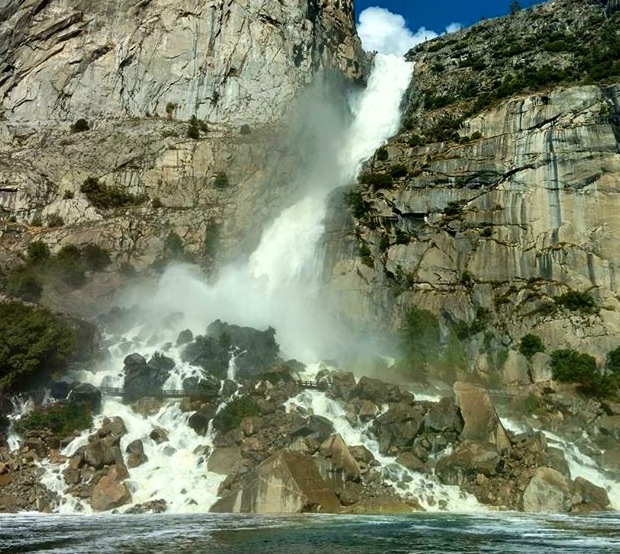
Wapama Falls won’t see this kind of volume in 2026. April and May will be the best times for waterfalls in Hetch Hetchy as well as in Yosemite Valley.
Wednesday’s headline in the The San Francisco Chronicle “California in for ‘ugly summer’ amid one of the worst snowpacks on record” was an attention grabber. How bad is it really?
Its worth checking in at the end of March – halfway through the 2026 “water year” (water years run from October through September).
The April 1 San Francisco Chronicle reports “State measurements on April 1, the closely watched date when snow levels historically reach their peaks, show that snowpack in the Sierra Nevada, southern Cascades and Klamath Mountains is a meager 18% of average.”
We aren’t sure where the 18% number comes from. The State’s estimates for rivers in the Sierra Nevada, including the Tuolumne, hover around 50% of average. See the California Data Exchange Center’s B-120 WATER SUPPLY FORECAST UPDATE SUMMARY for March 24.
While there is no such thing as an average year weather-wise, 2026 has indeed been odd. We had a large early season storm in November, significant rain in early January and a cold front bringing mostly snow at the end of February – and little else. Then a heat wave struck. San Francisco saw 90 degrees in March for the first time ever and Sierra snow started to melt quickly.
Focusing on the Tuolumne River (where, like much of the State, good record keeping goes back to 1922):
- For the entire water year, we are expecting 1,436,000 acre-feet, 78% of average.
- For the April-July snowmelt period, we are expecting 640,000 acre-feet, 54% of average.
It’s a dry year, for sure, but not among the driest. We hope for better next year. In addition to water supply concerns, park visitors will need to go earlier to see Yosemite’s waterfalls this year.
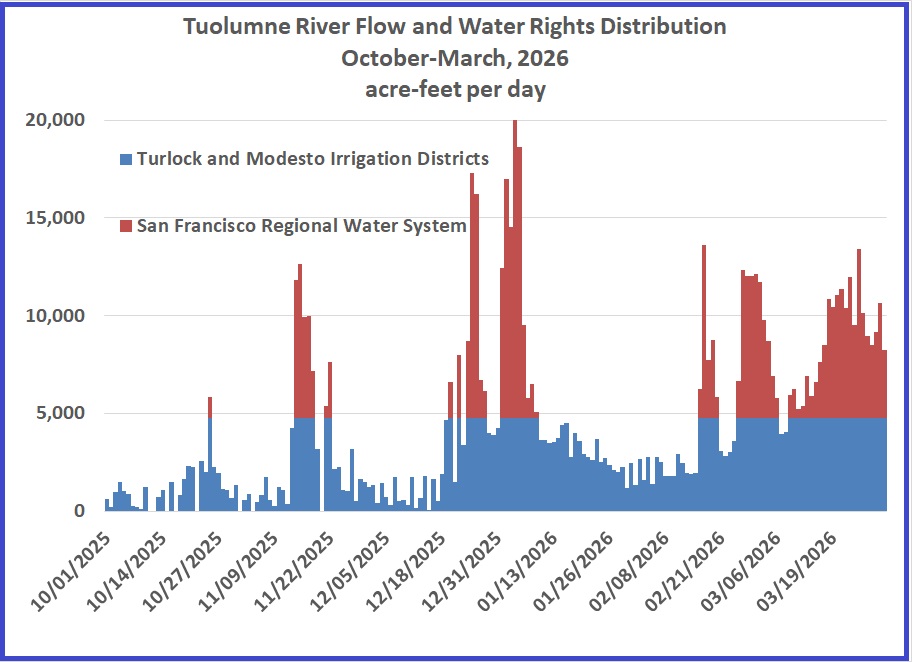
San Francisco’s total share of the Tuolumne River, determined by daily flows and shown in red, has well surpassed its annual demand, and will increase as the albeit meager snowpack continues to melt.
The Chronicle also notes the San Francisco Regional Water System has ample supplies: “The San Francisco Public Utilities Commission and East Bay Municipal Utility District, also among the big water providers in the Bay Area, operate reservoirs in the Sierra Nevada, which they say have ample water for the near term. Supply challenges for these agencies would arise after multiple dry years.”
This is an understatement. At least in San Francisco’s case, this year’s rain and snow has brought plenty of water – more that 300,000 acre-feet during the first six months of the year (compared to its demand of only 220,000 acre-feet for the entire water year). So the only impact may be that reservoirs will stop filling at the end of May rather than a month or so later).