by danielcmckenzie | Aug 12, 2019 | Uncategorized
After Thoughtful and Balanced News Story, San Francisco Chronicle Editors Retreat to Familiar Ground
Editorial: “The latest plan to drain the Hetch Hetchy water system doesn’t add up.”
The editorial department at the San Francisco Chronicle weighed in after last week’s excellent and somewhat sympathetic article on the potential value of restoring Yosemite National Park’s Hetch Hetchy Valley. Titled “The latest plan to drain the Hetch Hetchy water system doesn’t add up“, today’s editorial is consistent with previous positions the paper has taken.
Obviously, Restore Hetch Hetchy disagrees
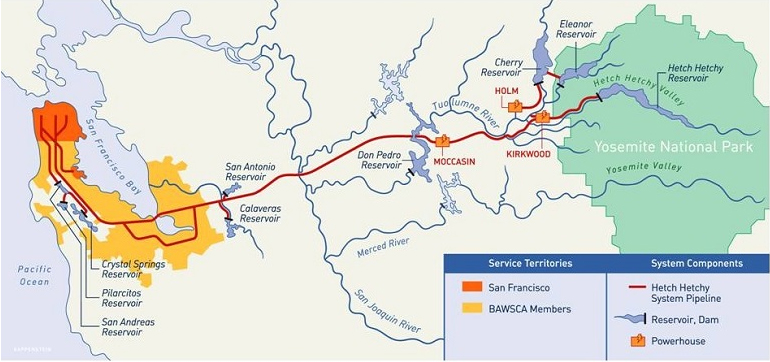
For starters, let’s note that no one has proposed draining the “system”. The San Francisco Public Utilities Commission stores water in nine reservoirs. We have suggested only one be emptied. Why does the editorial choose to confuse Hetch Hetchy Reservoir with the entire “system”?
And Restore Hetch Hetchy has always insisted that improvements be made so that not one drop of water supply is lost.
Let’s also note that the report, “Valuing Hetch Hetchy Valley: Economic Benefits of Restoration in Yosemite National Park” is not a “plan” and was never purported to be. The report itself makes clear that it does not address the system improvements that would be necessary and, even on the value side, recommends “a more detailed and extensive national survey, independently administered with collaborative and broad participation from government and stakeholders”.
Rather than examine the report on its merits …
…the Chronicle editors seem inclined to nip any discussion of restoration in the bud, as they have done in the past.
The editorial does make a few concessions. It queries “Who wouldn’t want another Yosemite Valley a few miles from the ultra-crowded one?”, and further acknowledges “It’s certainly true that such a project would be difficult, if not impossible, to enact today.”
Egregiously, the editorial characterizes Restore Hetch Hetchy as “starry-eyed”, and reminded readers that Mayor Ed Lee called restoration “insane”. We are provocative and ambitious, but we are absolutely practical. We understand every drop of water and every kilowatt of power needs replacement. The staff at the SFPUC understand this and generally respect us – even if most do not support our goal (some do, albeit quietly). A handful of politicians and a few in the media, however, prefer to brand us with hyperbole.
The editorial also opined that the report’s comparison of Hetch Hetchy to various dam projects was unwarranted. It claimed the dams on the Klamath that are scheduled for removal are “outmoded”, even though they produce twice as much hydropower as will be lost when Hetch Hetchy is restored. The editorial did not address steps taken by Los Angeles to restore Mono Lake – something once fiercely opposed by the City of Angels and now held up as a point of civic pride.
We think someday San Francisco will come around on Hetch Hetchy as Los Angeles has on Mono Lake. We are currently working, in-house and with expert assistance, on updated analysis of the water system improvements that could make Hetch Hetchy’s restoration possible. When that is complete, we will give the Chronicle editorial board another chance to consider our campaign.
Meanwhile, note the Chronicle has a strong and consistent record of supporting aquatic restoration projects in California – at least those that do not affect San Francisco. Here are a few examples:
Mono Lake
The Chronicle called Mono Lake “a splendid ecosystem”, concluding that “Every measure possible should be taken to restore this California treasure.”, even though restoration would limit the amount of water diverted to the “ever thirsty city of Angels” and noting that restoration can be accomplished by “refusing to bow to the greedy demands of Los Angelenos for water”. (September 22, 1994)
Bay-Delta
The Chronicle has consistently supported restoration of fisheries and wetlands in the Central Valley and Bay Delta, including the Central Valley Project Improvement Act (1992). Citing “salmon, striped bass and other fish had been devastated by the series of dams, canals and reservoirs built by the federal government in the 1930s and 1940s”, the Chronicle specifically supported reallocating 800,000 acre-feet of water (more than twice the volume of Hetch Hetchy Reservoir) to support fisheries rather than send it to Central Valley farmers. (January 3, 1996 and November 20, 1997)
Trinity River
The Chronicle has also supported restoration of the Trinity River in northern California, describing it as a “shadow of its free-flowing self” where “Salmon and steelhead stocks have plummeted to a tenth of pre-dam size, harming both the fishing industry and two Indian tribes”. The Chronicle called the diversions from the river to generate hydropower and provide water for agriculture “no small water grab”. (November 27, 2000)
Klamath River
The Chronicle has supported the removal of four hydropower dams on the Klamath River in an effort to restore salmon populations. The editorial’s title urges that we “Take down the dams”, noting that “an amazing change is suddenly attainable” and that “A river’s past could be restored.” (February 6, 2007)
But when it comes to the Tuolumne River and the Hetch Hetchy Reservoir (the only such facility ever built in a national park), the Chronicle has a decidedly negative view. One has to ask why.
Is restoring Yosemite National Park not as important or valuable as efforts to restore bird habitat at Mono Lake, or salmon and smelt populations in the Bay-Delta and on north coast rivers? If that is the Chronicle’s view, it should so opine.
Is Hetch Hetchy Reservoir such an indispensable part of supplying water for San Francisco and other Bay Area cities? Seems unlikely. By any stretch of imagination, the required water supply replacement would be far less than that required as a result of water export reductions in the Bay-Delta or on the Trinity River.
Is it the hydropower? Hydropower on the Tuolumne River, to be replaced with renewable resources, would be about what was lost when the Trinity River Plan went into effect and a fraction of what will be lost when the Klamath Dams are removed.
So are the Chronicle’s views of the potential to restore Hetch Hetchy based on the merits? Or is there a double standard at play?
by danielcmckenzie | Aug 9, 2019 | Uncategorized
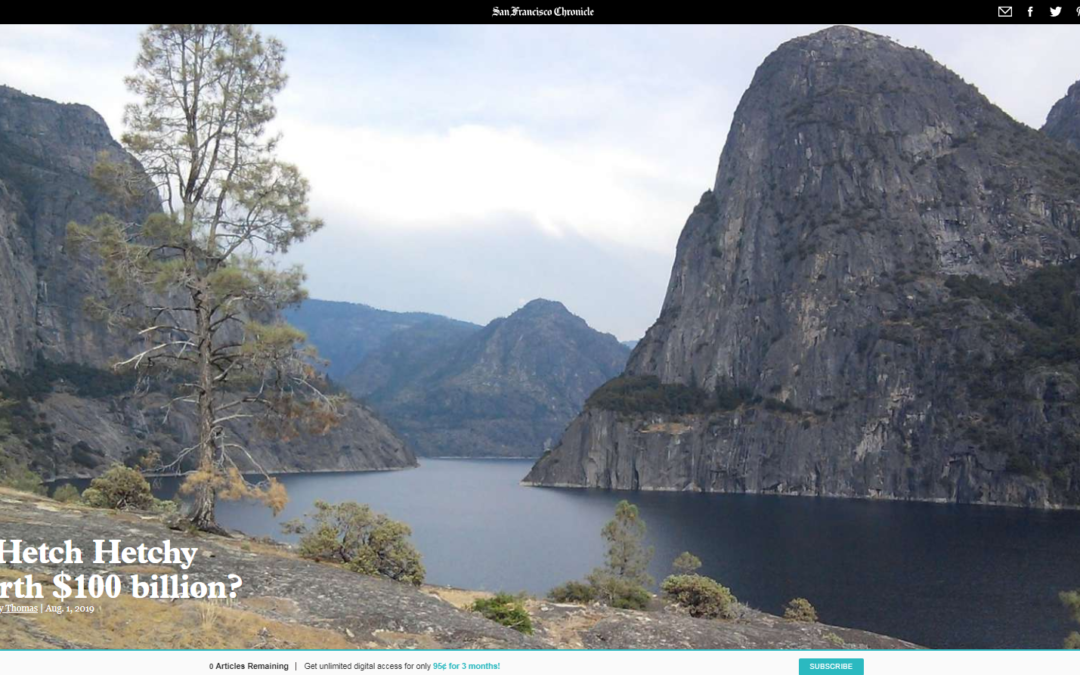
The San Francisco Chronicle posted “Is Hetch Hetchy worth $100 billion?” online on August 1, and on its front page on Sunday, August 4. The article is balanced and well worth reading.
Gregory Thomas, Chronicle Travel Editor and the article’s author, poses the pertinent question: “Draining the Bay Area’s water storage in Yosemite could open up a new outdoor mecca. Should we do it?”
Thomas briefly tells the story of Hetch Hetchy as an iconic landscape with an unfortunate legacy, then contemplates the wonders that restoration would provide. He thoughtfully provides the perspective of Dr. Mark Buckley, independent economist and author of “Valuing Hetch Hetchy Valley: Economic Benefits of Restoration in Yosemite National Park“, the groundbreaking report which inspired his article. Thomas also interviewed Dr. Michael Hanemann, renowned economist at UC Berkeley.
The article also provides fair and thoughtful treatment of Restore Hetch Hetchy. Most importantly, the article makes clear that Restore Hetch Hetchy is seeking a solution that would restore the valley without Bay Area residents losing a drop of water.
Appropriately, the article includes views from the other side – those of San Francisco Public Utilities Commission Deputy General Manager Michael Carlin. Carlin is an honorable opponent. His job is to supply customers in San Francisco and other Bay Area cities with reliable supplies of high-quality water. Restore Hetch Hetchy salutes Mr. Carlin and others at the SFPUC for their commitment to this essential public service.
To his credit, Carlin does not question the benefits of restoration – only its costs. “Without a comprehensive proposal, weighing the costs and benefits is impossible”, he says.
Restore Hetch Hetchy agrees with Carlin. We seek to develop that comprehensive proposal and have a public discussion that compares value of returning Hetch Hetchy to its natural splendor to the cost of the water system improvements necessary make restoration possible.
That is why we put such a proposal on the ballot in 2012 and filed suit in the California courts in 2015. In each case, however, San Francisco successfully prevented a proposal from being developed.
The release of “Valuing Hetch Hetchy Valley” is part of our effort to develop that proposal, encourage broad political support and force San Francisco to address the opportunity at hand. Stay tuned.
The mission of Restore Hetch Hetchy is to return the Hetch Hetchy Valley in Yosemite National Park to its natural splendor while continuing to meet the water and power needs of all communities that depend on the Tuolumne River.
by danielcmckenzie | Jul 22, 2019 | Uncategorized
This week we released Valuing Hetch Hetchy Valley: Economic Benefits of Restoration in Yosemite National Park. It is a thoughtful and well-researched report, and I hope you will take a close look.
Our press release is posted online and also copied below.
Restore Hetch Hetchy asked ECONorthwest, the report’s author, to evaluate a number of visitor-use scenarios for a restored valley, but instructed them to make no assumptions about developing any infrastructure (roads, lodges, campgrounds) within it. Restore Hetch Hetchy played no part in the study’s findings.
ECONorthwest found that the recreational value of a restored valley could be as much as $178 million per year: $62 million/year in visitor spending inside Yosemite National Park, $65 million/year in spending outside the park, and $51 million/year in additional consumer surplus. Also, by comparing Hetch Hetchy to other iconic western natural resources such as Grand Canyon, Mono Lake and Klamath River, the report concludes that the total increase in public value, including option values, bequest values and existence values, could exceed $100 billion over time.
I’ll acknowledge it’s a unusual to talk about the worth of a priceless treasure Hetch Hetchy in dollars, but we thought it was an important part of the conversation so we asked ECONorthwest to do so.
Finally, there has been a lot of talk, and disagreement, about cost. We are actively updating previous work in that area to incorporate important changes in law and technology, as well as to address the prospect of climate change.
Valuing Hetch Hetchy Valley is available online. Let us know if you would like hard copy.
We have shared Valuing Hetch Hetchy Valley broadly, sending copies to San Francisco’s Mayor and Supervisors, the San Francisco Public Utilities Commission and its Bay Area wholesale customers (BAWSCA), the Newsom Administration, the Department of the Interior and dozens of members of Congress, among others. (See, for example, the cover letter included with the report sent to Governor Newsom).
Value of Yosemite’s Hetch Hetchy Valley Restoration Could Reach $100 Billion or More
New report from ECONorthwest finds recreational value could reach $178 million a year alone; “Valuing Hetch Hetchy Valley: Economic Benefits of Restoration in Yosemite National Park,’ commissioned by Restore Hetch Hetchy, reinforces case for restoration
Berkeley, CA – July 17, 2019 – – The recreational value of restoring Yosemite’s Hetch Hetchy Valley could reach $178 million per year, according to a new independent report from ECONorthwest, including:
- $62 million in visitor spending inside Yosemite National Park,
- $65 million in spending outside the park, and
- $51 million in consumer surplus.
Benefits from recreation use over 50 years could be worth
- $1.5 to $4.6 billion (with time discounting), or
- $3 to $9 billion undiscounted.
Factoring in passive use, including option values, bequest values and existence values, the report, “Valuing Hetch Hetchy Valley: Economic Benefits of Restoration in Yosemite National Park” finds the value of restoration could reach $100 billion dollars for Americans alone.
The value of restoration, as found by ECONorthwest, reflects the importance Americans place on iconic natural resources, and is consistent with recent polling data, conducted by Probolsky Research, which found that support for restoration outnumbered opposition by more than 3 to 1.
“This study by ECONorthwest makes a convincing case that there could be substantial economic benefits if Hetch Hetchy were to be restored, including recreation benefits for millions of visitors from California and elsewhere,” said Dr. Michael Hanemann, Chancellor’s Professor Emeritus in the Department of Agricultural & Resource Economics at UC Berkeley. “They would be attracted by the same types of recreation opportunities as at Yosemite, but with less congestion. In addition, others who might not themselves visit would place significant economic value on the restoration of an iconic element in California’s environmental heritage.”
ECONorthwest, the Pacific Northwest’s largest and most respected economic consulting firm, was tasked with quantifying the benefits of restoration in economic terms, considering a variety of visitor use scenarios without any assumption of whether infrastructure within the valley itself would be developed Restore Hetch Hetchy commissioned the report, but played no part in ECONorthwest’s economic analysis or findings.
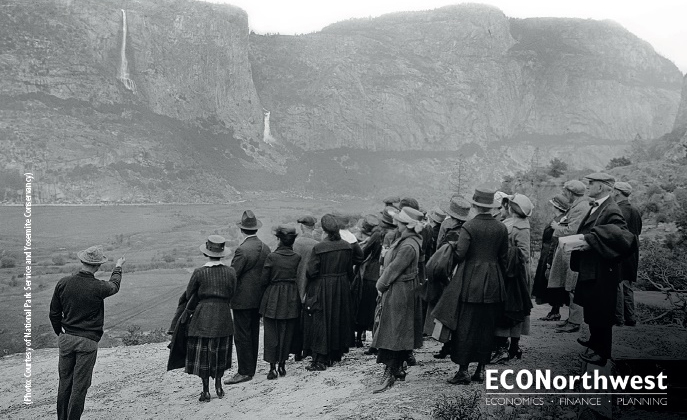
Hetch Hetchy was once a resplendent glacier carved valley, with towering cliffs and waterfalls cascading onto a serene valley floor. Pioneer conservationist John Muir called it a “remarkably exact counterpart” to the now world-famous Yosemite Valley – 15 miles to its south. But in 1913, the United States allowed Hetch Hetchy Valley to be dammed and flooded by San Francisco. It was the only time in American history that such destruction has been allowed in any of our national parks. Restore Hetch Hetchy is committed to undoing that destruction while ensuring San Francisco’s water supplies are kept whole.
“We believe that the iconic Hetch Hetchy Valley is priceless; but a realistic case for restoration must include economic analysis, and this report offers a critical argument for the dollars and cents benefits of restoration, without bias,” said Spreck Rosekrans, Executive Director of Restore Hetch Hetchy. “By including the application of data from Yosemite Valley, the Grand Canyon, Mono Lake, the Klamath River and other locations to Hetch Hetchy, this report underscores the unprecedented opportunity restoration offers.”
A downloadable copy of ‘Valuing Hetch Hetchy Valley: Economic Benefits of Restoration in Yosemite National Park,” is available at www.hetchhetchy.org/reports.
We will gladly arrange interviews with ECONorthwest’s Mark Buckley, principal author of the report, as well as with Restore Hetch Hetchy Executive Director Spreck Rosekrans.
ABOUT RESTORE HETCH HETCHY: The mission of Restore Hetch Hetchy is to return the Hetch Hetchy Valley in Yosemite National Park to its natural splendor while continuing to meet the water and power needs of all communities that depend on the Tuolumne River.

by danielcmckenzie | Jun 21, 2019 | Uncategorized
The mission, and purpose, of Restore Hetch Hetchy has long been to return the Hetch Hetchy Valley in Yosemite National Park to its natural splendor. That will never change.
As part of the campaign for restoration, we have decided to advocate that certain human- or electric-powered boats be allowed on Hetch Hetchy Reservoir. To this end, on June 21, 2019, we wrote to Secretary of the Interior David Bernhardt and Mayor of San Francisco London Breed (see letter, cosigned by California Trout). We plan to follow up.
There are two principal reasons.
First, boating on Hetch Hetchy Reservoir would provide access and recreation benefits not currently available to park visitors. Some visitors would tour the entire Hetch Hetchy canyon by boat. Others might disembark to fish, climb, hike or picnic. Just as visitors to Yosemite Valley venture out of the valley proper to Vernal Falls, Mirror Lake, etc. visitors to Hetch Hetchy would be able to visit Rancheria Falls and the Grand Canyon of the Tuolumne – even while the reservoir is in place. These are exciting opportunities.
Note also that boating on Hetch Hetchy Reservoir would also be an attractive option for those unable to hike Yosemite’s trails, including military veterans disabled while serving our country.
Second, visitors to Hetch Hetchy will have the opportunity to learn the whole story – that its damming was the greatest destruction ever allowed in any of our national parks, and that San Francisco can make water supply improvements so that Hetch Hetchy Valley can be restored. Some visitors might develop an affinity for keeping the reservoir, but we believe the overwhelming majority will want to see the valley beneath come to life.
When the City lobbied Congress for permission to build the dam, it committed to share Hetch Hetchy with the American people. San Francisco promised that the area would be used “for park purposes and for water supply purposes”, that there would be “no reason to exclude campers and picnickers” and that it would be “absurd” to claim otherwise.
There’s no question that exploring the Hetch Hetchy canyon by boat is a far cry from “standing waist deep in wildflowers on a sunny day in June” – as John Muir described his own experience in Hetch Hetchy Valley. It’s an experience that visitors to Yosemite will much appreciate, however, and furthermore it will draw greater attention to San Francisco’s special deal and the opportunity to return the valley to its natural splendor.
San Francisco has long received its benefits from the Raker Act. The public, however, has been shortchanged. It’s time to welcome park visitors back to Hetch Hetchy.
Until Hetch Hetchy Valley is restored, access to the Hetch Hetchy canyon should include boating on the reservoir.
by danielcmckenzie | Apr 6, 2019 | Uncategorized
Klamath dam removal is not about water supply.
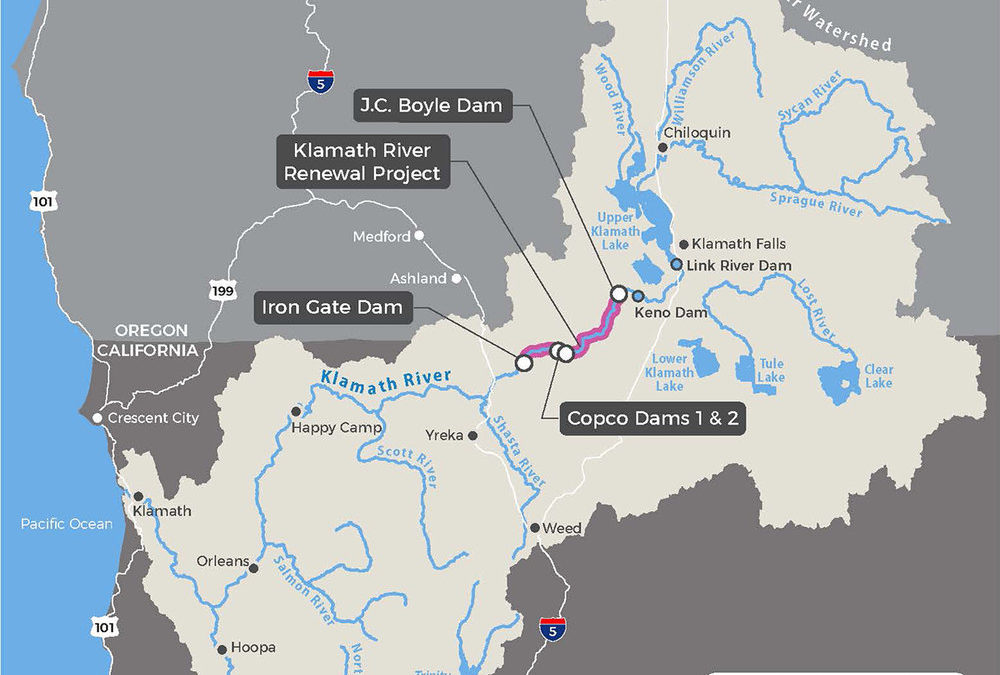
The headline, “Plan to Demolish 4 Hydroelectric Dams on Klamath River Stirs Debate Over Coveted West Water“, published this past week by the Associated Press is misleading. The dams on the Klamath produce hydropower, but they lie downstream of the agricultural diversions in the Klamath Basin and their removal will not affect those diversions.
Probably it is not the reporter’s fault. Editors write the headlines, and too often they select one to grab a reader’s attention, even if it is unwarranted (if it bleeds, it leads, as they say).
Fundamentally, the conflict on the Klamath is about hydropower. The four Klamath dams produce about 690 gigawatt-hours of electricity per year. The restoration of Hetch Hetchy will result in a loss of about 350 gigawatt-hours per year – half the Klamath value.
The problems caused by the Klamath Dams are twofold. Like all dams, they impede upstream migration of the salmon. But these dams also also serve as incubators in the summer, when hot weather, combined with agricultural runoff from the upstream basin, produces toxic algal blooms. The river’s water quality should be much improved once the dams are gone.
If you’ve never been to the area, it is well worth a trip north to explore the Klamath River, as well as the Trinity, Salmon and other tributaries.
Our challenge at Restore Hetch Hetchy is different. We do need to protect San Francisco’s access to Tuolumne water supplies. We need to ensure that not a drop is lost when the water is taken downstream of Hetch Hetchy.
Even in our case, however, the water supply concern is frequently overstated. So often, the media describe Hetch Hetchy as the source of San Francisco’s water. It is not the source. It is a storage tank – holding about 1/4 of San Francisco’s supply. And it does not belong in Yosemite National Park.