
San Diego has an excess of water. So it is selling some of its supply to Las Vegas and Arizona. See the Wall Street Journal story “San Diego now has so much water that it’s selling it”
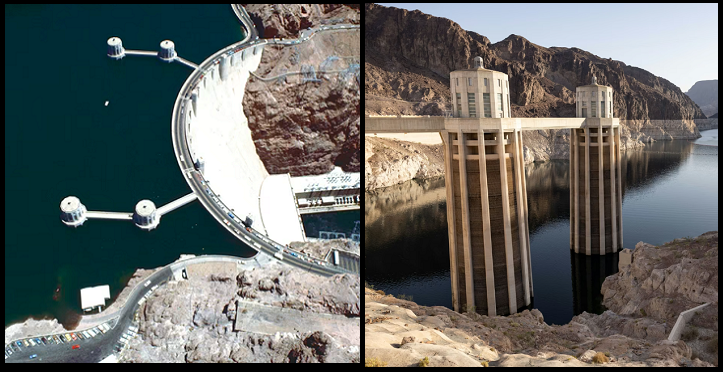
As a result of the highly-publicized, long-term decline in Colorado River supplies, Las Vegas and Arizona are eager to find additional water. Shown above are Lake Mead’s intake towers in 1983 and 2022.
Water markets are often controversial and are institutionally complex. So buying and selling of supplies between water agencies happens less than it should and many areas do not have sufficient incentives to use water efficiently. (More on this philosophy below.)
San Diego’s surplus is the result of three things:
- Investment in the Claude “Bud” Lewis Carlsbad Desalination Plant,
- Investment in its Pure Water recycling program, and
- Reduced demand.
Recycling and desalination both rely on the same core technology – using energy to squeeze water through high-efficiency membrane filters (aka nanofilters). Desalination, however requires far more energy due to the high salt content of ocean water. In addition, the disposal of excess brine is problematic and nobody wants a desalination plant on their beach.
San Diego’s “Pure Water” recycling project, however, is intriguing from an environmental perspective. Its genesis is not simply from the desire for more water, but also from mandates to reduce pollution from its Point Loma wastewater plant. See our Fall 2021 Newsletter story.
Additionally, urban water demand in San Diego has dropped, as it has throughout the state. People are watering fewer lawns and indoor fixtures are more efficient than ever.
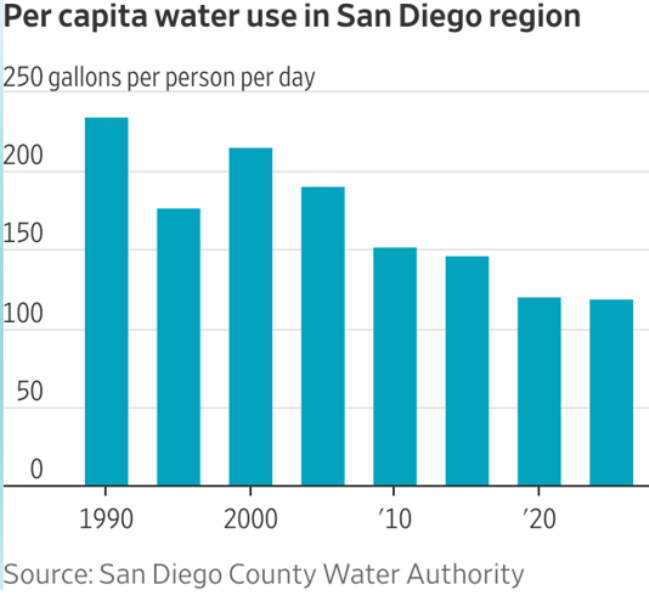
As a result of its overinvestment, San Diego will be selling water to Las Vegas and Arizona, areas that are seeing reduction in their supplies from the Colorado River. This will bring at least some rate relief in San Diego. We can think of it as selling desalinated and recycled water, but the inland customers will actually be using Colorado River water that would otherwise go to San Diego.
At Restore Hetch Hetchy, we are pleased these agencies are doing business. As noted above, we are fans of San Diego’s recycling project but we are not fans of desalination (it’s an expensive, harmful technology we don’t need at this time and hopefully never will).
As promised above a bit more on selling water, first published on World Water Day in 2010
Balancing the Water Business and the Public Trust
By Spreck Rosekrans | Published: October 15, 2010
Aristotle was right. Water, along with earth, air and fire, is a one of the primary elements upon which life depends. Water is essential for our homes, our businesses, and especially for our farms. Water also is the great elixir that sustains fish, wildlife and the natural world.
Across the globe, as a result of increases in population, depletion of groundwater basins and the uncertainty of future precipitation, shortages of this precious fluid continue to become more commonplace. Providing reliable water supplies requires both cost-effective
investments in infrastructure as well as policies and incentives to ensure that existing supplies are used fairly and efficiently.
There is a fundamental public interest or trust in water which requires that the environment and local communities be provided sufficient supplies and protected from more powerful and often remote economic interests. As water supplies decline, citizens in the 21st century should plan to monitor governmental management of water closely and to ensure that these indispensable public values are protected.
However, the private sector has an important role to play as well. Improvements in efficiency as well as evolving human and environmental needs will inevitably bring about changes in water use patterns. A business model — with appropriate constraints — should be employed that allows and encourages innovation. In many cases, water should be marketed to those who can use it most efficiently and productively. More opportunity for appropriate water marketing will bring out the best ideas that resourceful water users, urban and agricultural alike, can implement.
By improving efficiency in cities and on farms, economic incentives will help maximize food production and meet business needs while optimizing the use of limited water supplies. As a result, it will be easier to meet basic human needs and to reduce the pressure to extract ever increasing amounts of water from our rivers and streams.