
Electricity is part of our daily lives. We need to use it wisely and do what we can to diminish the harm from its production. The transition from fossil fuels to renewable power has been remarkable, with more expected as battery technologies improve. We have also seen relatively small but important reductions to hydropower as we seek to bring our rivers back to life.
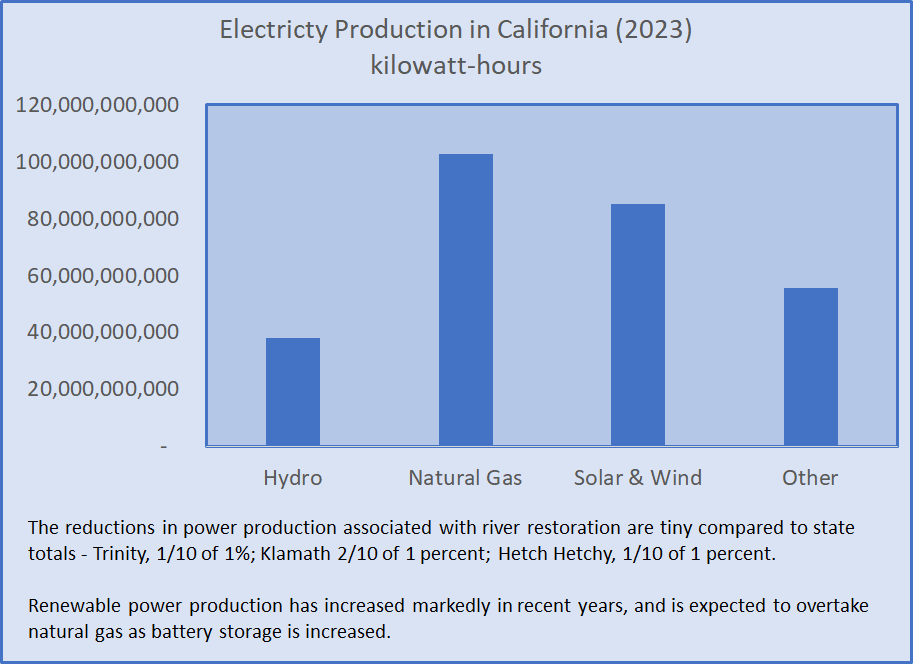
In California and the American West, we have built large dams to control the flow of water. These dams create water supply, hydropower and flood reduction benefits. Dams also destroy rivers, flood riparian corridors, eliminate fisheries and diminish recreational activities. Balancing the benefits with the destruction is often the subject of robust public debate, both for proposed projects and for projects already completed.
Recent decades have seen changes that favor the natural flow of rivers, rather than their taming to extract every last dollar.
Trinity River
The 1992 Central Valley Project Improvement Act authorized the Department of the Interior to create and implement a plan to improve California’s Trinity River – the largest tributary of the Klamath River. Since Trinity Dam was built in the early 1960s, the bulk of the river’s flow had been diverted into the Central Valley where it generates hydropower and ultimately increases water supply to farmers in the San Joaquin Valley.
In 2000, Interior adopted a plan to reduce those diversions and to restore the health of the Trinity River. The litigious Westlands Water District and the Northern California Power Agency (NPCA) sued to stop the plan; the Hoopa Valley Tribe, whose reservation is bisected by the river, intervened on behalf of Interior. Public pressure convinced NCPA members Palo Alto, Alameda, Port of Oakland and Healdsburg to withdraw, creating an unprecedented rift within NPCA.
The court eventually ruled for Interior. Average hydropower production created by the Trinity’s diversions has been reduced by about 322,000,000 kWh per year. (How much is this? If every one of 40,000,000 Californians ran a 1 kilowatt toaster for 8 hours, they would use 320,000,000 kWh.)
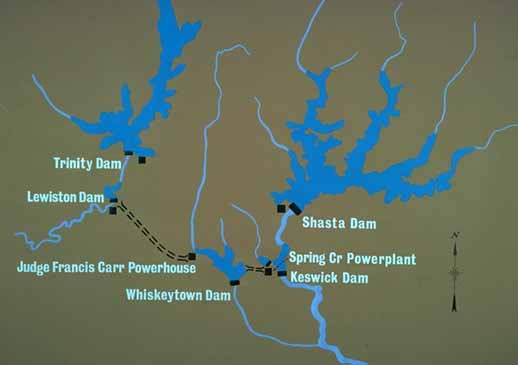
Professor Emeritus Luna Leopold called the methodology for restoring the Trinity River “the best thing I have seen in three decades”. The restoration plan (in part) requires more of the Trinity’s natural flow to be left in the river and less diverted to the Central Valley through the Carr and Spring Creek Powerplants.
Klamath River
The removal of four dams (J.C. Boyle, Iron Gate and Copco 1 & 2) on the Klamath River has eliminated production of hydropower. From 1974 to 2023, these dams produced an average of 596,000,000 kWh per year.
The dam removals both improve water quality and expand salmon habitat, and are widely celebrated by boaters and recreational fishermen, as well as the tribes (Yurok, Karok and the aforementioned Hoopa Valley) who have depended on the river and its salmon for both culture and sustenance for millennia.
Tuolumne River and Hetch Hetchy
San Francisco operates three power plants in the Tuolumne watershed: (1) Kirkwood, fed by releases from Hetch Hetchy Reservoir, (2) Holm, fed by releases from Cherry Reservoir and (3) Moccasin, fed by diversions in the upper river before being conveyed to San Francisco.
Restore Hetch Hetchy’s Cherry Intertie Alternative proposes that water from Cherry reservoir be allowed to generate power at Holm, then rerouted to generate power at Moccasin before being conveyed to the Bay Area. Under this scenario, there would be little change in hydropower generation at Holm and Moccasin, but generation at Kirkwood would only be possible during winter and spring when there is substantial natural flow in the Tuolumne River.
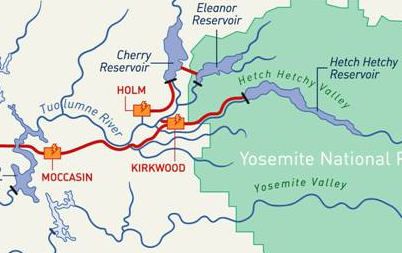
Restore Hetch Hetchy’s proposal to divert water from Holm Powerplant into the conveyance system is based on engineering produced by San Francisco’s own consultants.
Restore Hetch Hetchy understands that San Francisco will need to make system improvements to retain the hydropower and water supply benefits that their system provides. Those improvements are fully achievable and are long overdue.