by Spreck | Aug 22, 2026 | Uncategorized
Hetch Hetchy and Glen Canyon are often cited as the most controversial dams in the United States. In both cases, wild landscapes were sacrificed for water and power needs, and two of the American West’s most stunning river canyons were buried under reservoirs.
Restore Hetch Hetchy is dedicated to returning to the people Yosemite Valley’s lost twin, Hetch Hetchy – a majestic glacier-carved valley with towering cliffs and waterfalls, an untamed place where river and wildlife run free, a new kind of national park. The Glen Canyon Institute is dedicated to the restoration of Glen Canyon and a free flowing Colorado River through Grand Canyon.
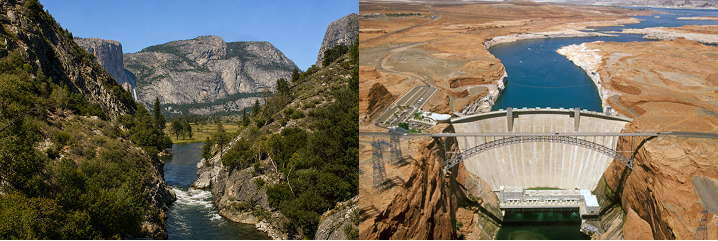
Dams at Hetch Hetchy and Glen Canyon were built, naturally, at narrow spots in their respective river canyons. Hetch Hetchy Reservoir (360,000 acre-feet) is tiny compared to Glen Canyon, only 1/67th as large.
San Francisco lobbied for more than a decade to build a dam at Hetch Hetchy, and was initially repulsed by the U.S. government with the support of John Muir and his nascent Sierra Club. In 1913, however, Congress passed and President Wilson signed the Raker Act in 2013, allowing the City to build O’Shaughnessy Dam in Yosemite’s Hetch Hetchy Valley. The controversy turned the Sierra Club from an outing club to a political organization, as explained by author Robert Righter in “The Battle over Hetch Hetchy: America’s Most Controversial Dam and the Birth of Modern Environmentalism.”
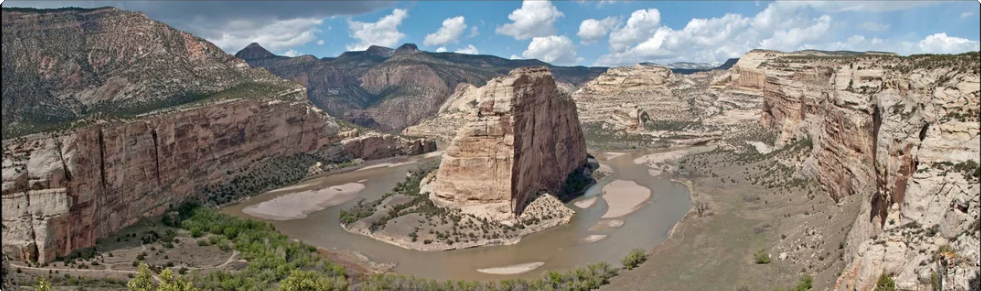
Glen Canyon Dam was built in the late 1950s and early 1960s after the United State Government struck a compromise with the Sierra Club, led by David Brower. The Sierra Club had opposed the Bureau of Reclamation’s plan to build a dam upstream on the Green River that would have flooded Echo Park and acquiesced to building Glen Canyon Dam instead. Brower soon regretted the compromise, co-authoring a book (with Eliot Porter) called The Place No One Knew: Glen Canyon on the Colorado.
Steamboat Rock at the confluence of the Green and Yampa Rivers (tributary to the Colorado) in Echo Park within Dinosaur National Monument.
Restore Hetch Hetchy and the Glen Canyon Institute are further connected. Prior to a Congressional hearing in the mid 1990s , David Brower had worked with current RHH Executive Director Spreck Rosekrans on testimony regarding the limited utility of Glen Canyon Dam for water storage. Brower later recommended Rosekrans to Ron Good who was assembling the team that ultimately became Restore Hetch Hetchy.
Impending reductions in water supplies from the Colorado River have been prevalent in the news in 2026. The situation, however, has been steadily worsening since the 1980s – the last and only time that the river’s two huge reservoirs, Lake Mead (27,000,000 acre-feet behind Hoover Dam) and Lake Powell (24,000,000 acre-feet behind Glen Canyon Dam) were full. Increasing demand for water coupled with deceased runoff have seriously depleted both reservoirs, threatening their ability to deliver water and generate hydropower.
Allocations of Colorado River water are based on the Colorado River Compact of 1922, which relied on records from a particularly wet period to divide the river equally between the upper basin states (Wyoming, Colorado, Utah and New Mexico) and lower basin states (California, Arizona and Nevada) – with subsequent adjustments for Mexico. Storage has been depleted even without the upper basin states taking their full share; the Trump Administration has decreed the lower basin states must bear the burden of sharp reductions.
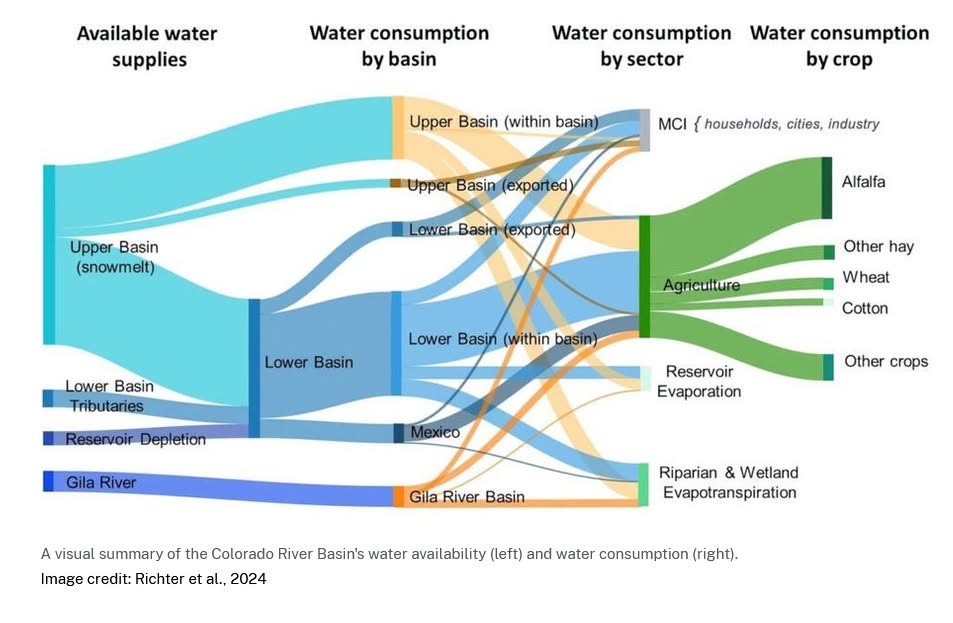
We don’t know whether the Administration’s edicts will simply be adopted or whether lawsuits and negotiations will follow. Urban southern California has been investing heavily in water recycling (see Yosemite’s Opportunity, page 5 ). Arizona may have the toughest time adjusting.
As the graphic shows, the bulk of the Colorado’s flow goes not to cities but to agriculture. Of course, food that is grown on farms goes to cities for people to eat. There is no getting around the requirement to use water to grow food.
But one crop stands out – alfalfa. Alfalfa feeds cattle and thus supports the dairy and beef industries. Arizona and California, with long growing seasons, have the highest yields on a per acre basis – twice that of Midwest states. But Midwest states don’t need to irrigate their alfalfa. Should “we” move alfalfa eats?
It’s tempting to say, let the market work this out – and the market will indeed do so to some degree. But water rights are based on history and politics, and have very little to do with the market. So the solution on the Colorado, whatever it is, will be a combination of law, politics and market economics.
While Lake Powell is at record low levels, it is not empty so Glen Canyon is not yet restored. There are credible arguments that total losses would be reduced if all storage was moved downstream to Lake Mead (while the rate of evaporation at the hotter downstream location is higher, bank seepage in the porous sandstone of Glen Canyon would be largely eliminated). The principal challenge to this approach might be massive institutional hubris as the federal Bureau of Reclamation would not want to concede that Glen Canyon Dam was never a particularly good idea.
Hubris also appears to be a barrier with officials in San Francisco. They are collectively reluctant to concede in any public way that San Francisco is the only city to build a dam in national park and that it could be restored with relatively simple water system improvements that have been commonplace throughout California. It’s time for city institutions to confront the damage it has caused by building America’s Most Controversial Dam and look to solutions that will make Yosemite National Park whole once again.
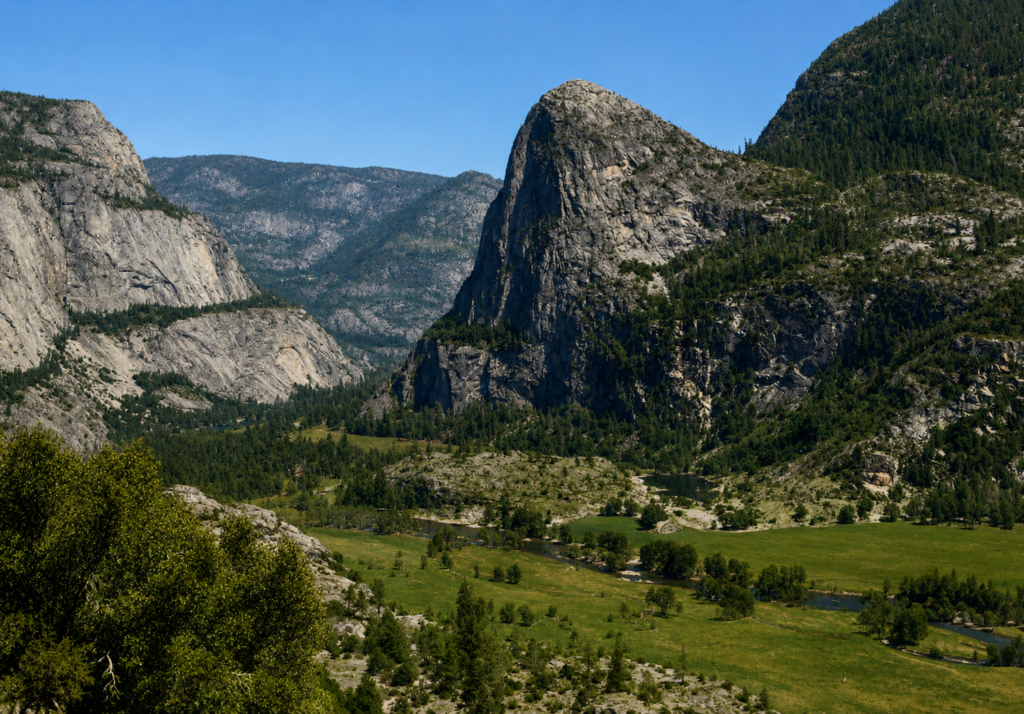
Photo Herbert Gleason (enhanced)
by Spreck | Aug 2, 2026 | Uncategorized
A few quick updates:
Fishing at Calaveras Reservoir
San Francisco’s Calaveras Reservoir is one of only two reservoirs in California holding over 75,000 acre-feet of water that does not allow fishing (now that fishing is allowed in Hetch Hetchy Reservoir!) – and only one of three such reservoirs that does not allow boating. We have been tracking Tim Dummer’s impressive efforts over the last several years to gain fishing access to Calaveras Reservoir.
Dummer has had success in the courts, but now they are giving him the runaround. His attorney, Greg Glaser, has filed an appeal. Without getting into the weeds of the case, we were happy to file an amici brief, along with Northern California Council Fly Fishers International (thanks to RHH Board Secretary and attorney Mark Palley for the legal work). UC Davis law professor Karrigan Bork is among others who have also submitted an amicus brief.
Fishing at Hetch Hetchy Reservoir, new this year, is expected to be popular. Fishing the Tuolumne River after the valley is restored will be phenomenal.
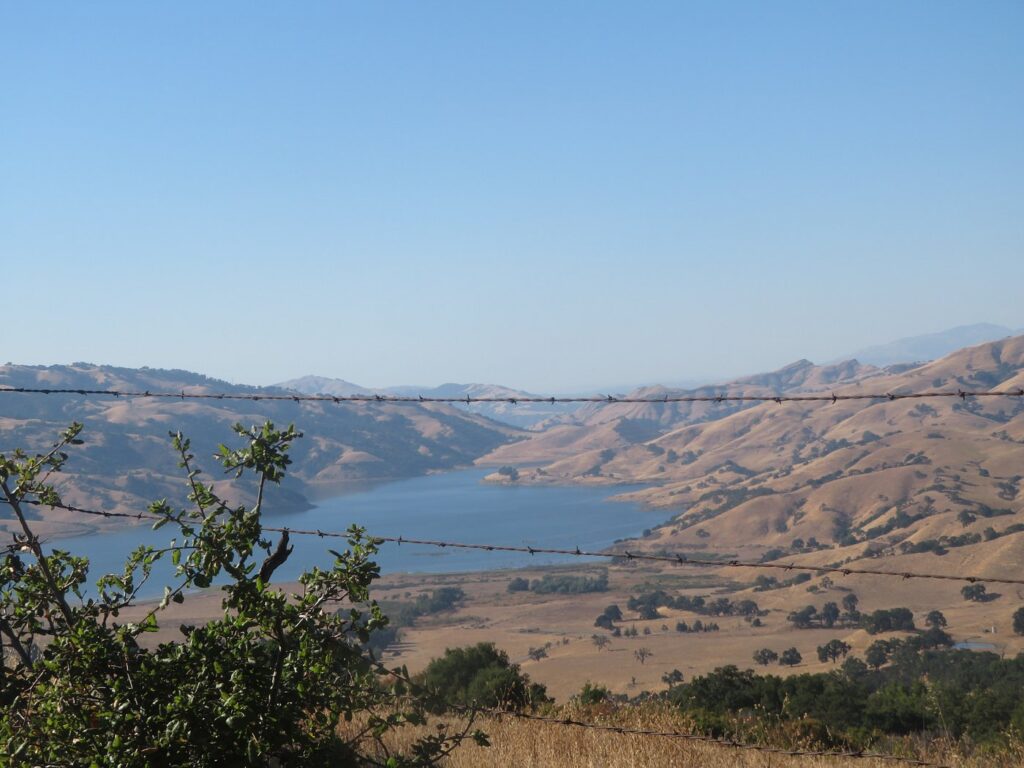
Calaveras Reservoir (Alameda County) is San Francisco’s largest reservoir in the Bay Area. The City restricts access to its reservoirs and on its watershed lands more so than other water agencies.
Crowds in Yosemite
The Los Angeles Times’ Jaclyn Cosgrove recent column on crowding in Yosemite tells some excoriating tales and compares Yosemite to Disneyland. There is some truth to this assertion, especially in summer months.
Cosgrove briefly discusses the legacy of Hetch Hetchy and laments that it is no longer “a place to find a little quiet.” That statement is true principally on spring weekends when Hetch Hetchy’s lone principal trail draws hikers on a pilgrimage to the spectacular Wapama Falls.
Except for those few days, Hetch Hetchy is still underused. Restore Hetch Hetchy is encouraging the National Park Service to allow camping at Hetch Hetchy after San Francisco fulfills its legal commitment to provide potable water to the (currently restricted) campground.
When Hetch Hetchy is restored, we will have a blank slate for managing the valley in a way that accommodates visitors without substantial traffic and congestion. There will surely be differences of opinion, but we are confident restoration will be magnificent and will provide an inspiring alternative to Yosemite Valley.
Hetch Hetchy Debate
We are looking forward to a debate on the future of Hetch Hetchy on October 20, at Manny’s in the Mission District. If you are nearby, please join us.
Our opponent with be Adrian Covert of the Bay Area Council, our worthy (and sometimes hyperbolic opposition). The Bay Area council represents some of the world’s largest businesses, including Apple, Google, Facebook, and Bank of America. Rather than oppose restoration, these companies could and should pay for much of the cost of restoration simply by rummaging under the couch cushions for spare change.
Thanks in advance to Manny’s for hosting and to Laura McFarland of Coro California for moderating the discussion. For tickets go to Eventbrite.
by Spreck | Jul 18, 2026 | Uncategorized
Yosemite National Park’s Hetch Hetchy Valley is perhaps the best known example of a spectacular landscape that was initially protected but subsequently developed.
Threats to protected lands continue. On Monday, July 13, President Donald Trump signed Executive Orders reducing the size of The Escalante – Grand Staircase and Bears Ears National Monuments.
The damming of Hetch Hetchy was accomplished through legislative means – when Congress passed the Raker Act. (Shenanigans were at play – William Randolph Hearst and his San Francisco Examiner were later successfully sued for libeling engineer Taggart Aston for daring to advocate for an alternative water project.)
President Trump intends to reduce the national monuments with a mere stroke of the pen. It seems doubtful that his action is legal, but we won’t know for certain until the actions are adjudicated by the courts.
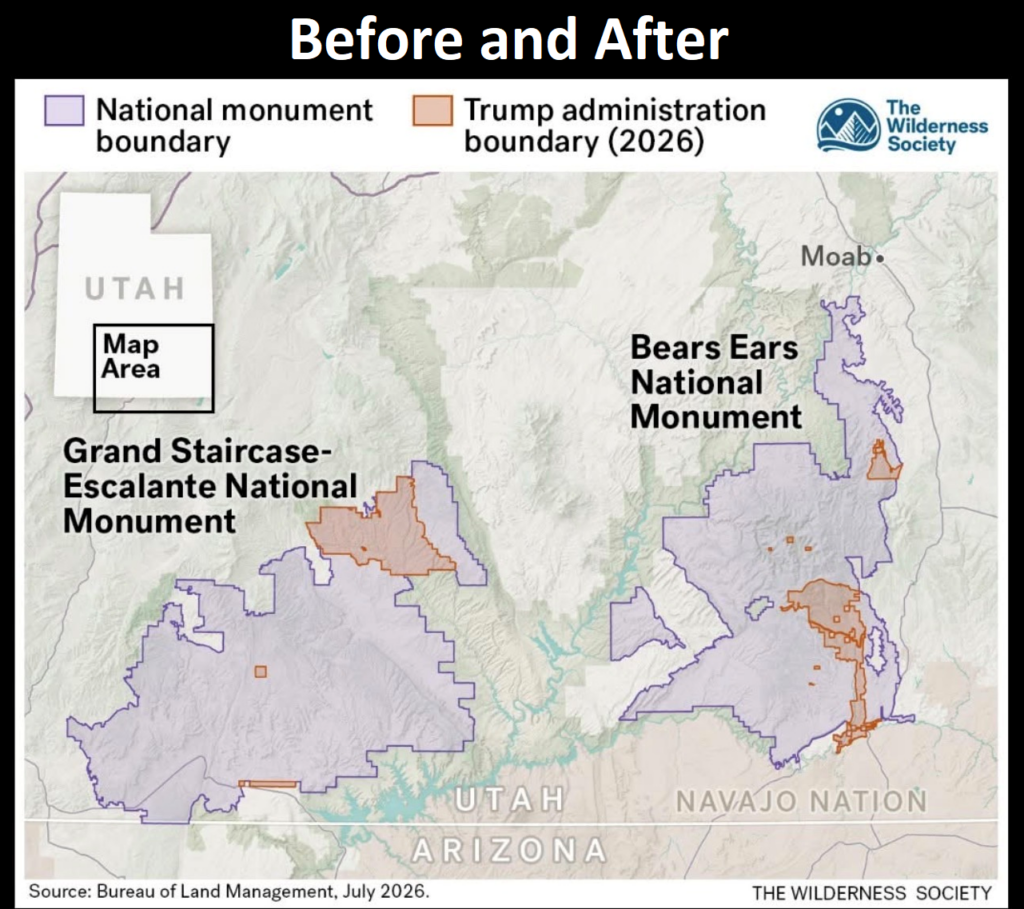
President Trump’s Executive orders, if upheld, would reduce the size of the monuments by more than 2,500,000 acres.
Lawsuits quickly followed Trump’s actions. The Bears Ears Commission (Hopi Tribe, Navajo Nation, Ute Mountain Ute Tribe, Zuni Tribe, and the Ute Indian Tribe of the Uintah & Ouray Reservation), Earthjustice and the Southern Utah Wilderness Alliance oppose the order and President’s legal authority to issue it. The order is supported by the State of Utah and local county governments.
At both monuments, there is a basic conflict between preserving natural landscapes and developing lands for mining coal and uranium. (Claims of opening access for hunting & fishing appear to have limited or no merit.) A fundamental unresolved issue, lingering for more than a century, is what right, if any, a President has to reduce the size of a national monument.
The primary purpose of the (very short) Antiquities Act, passed in 1906, was to give President Theodore Roosevelt power to prevent the looting of indigenous artifacts at Mesa Verde in Colorado. Roosevelt used the act to designate 18 monuments in all. Some, including the Grand Canyon and Mount Olympus, were later designated as national parks by Congress.
President Clinton designated the Escalante – Grand Staircase in 1996. Bears Ears is more recent and is the site of a tug-of-war between administrations over the last decade
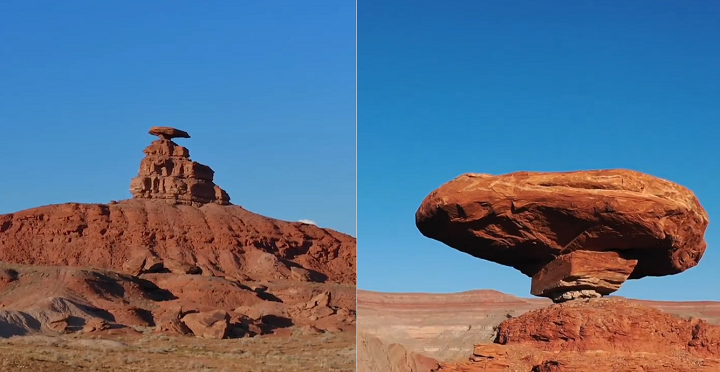
Mexican Hat, the famous rock formation, and nearby namesake hamlet lie just outside of Bears Ears.
- In 2015, the five sovereign nations formally united to form the Bears Ears Inter-Tribal Coalition, and petitioned the federal government to protect 1.9 million acres of land from looting, vandalism, and resource extraction.
- 2016, President Barack Obama used the 1906 Antiquities Act to establish Bears Ears National Monument, initially protecting roughly 1.35 million acres and establishing a tribal commission to manage the land directly with federal agencies.
- In 2017, President Trump signed an executive order reducing the monuments to 201,876 acres and splitting it into two smaller units: Indian Creek and Shash Jáa.
- In 2021, President Joe Biden restored the boundaries to 1.36 million acres and reinstated the joint-management partnership between the federal government and tribal nations.
- In 2026, President Trump scaled back the boundaries a second time, shrinking the monument to 121,100 acres, intending to open the area to mining – primarily coal and uranium.
Restore Hetch Hetchy is keenly aware that it is harder to restore a landscape once developed than to prevent development in the first place. As we have seen with a variety of dam removals, however, riverine environments come back quickly – a prospect that is truly inspiring for us.
Undoing the effects of large scale mining in southern Utah’s spectacular canyons, however, may not be possible. That’s why it makes sense for a law like the Antiquities Act to allow a President to protect an area but not to develop it. If development is truly warranted, let it survive the deliberative legislative process.
The language of the Antiquities Act does not provide any mechanism for reducing the size of a national monument. President Woodrow Wilson did, however, substantially reduce the size of Mt. Olympus National Monument (now Olympic National Park) in 1915, citing “The Great War” as rationale – but that and the handful of other reductions in the 20th century were never challenged.
Trump’s legal argument rests on the phrase “the smallest area compatible with the proper care and management of the objects to be protected” in Section 2 of the Antiquities Act. His previous attempt to reduce the monuments, in 2017, however, were rebuked by the Tenth Circuit Court of Appeals.
We hope the courts will continue to rule in favor of protecting public lands and further that Congress will respect and honor the wonderful landscapes of southern Utah and the local tribes who have lived there for millennia.
By the way, if you haven’t explored southern Utah, do it. The sandstone canyons, mountains and rivers are truly phenomenal.
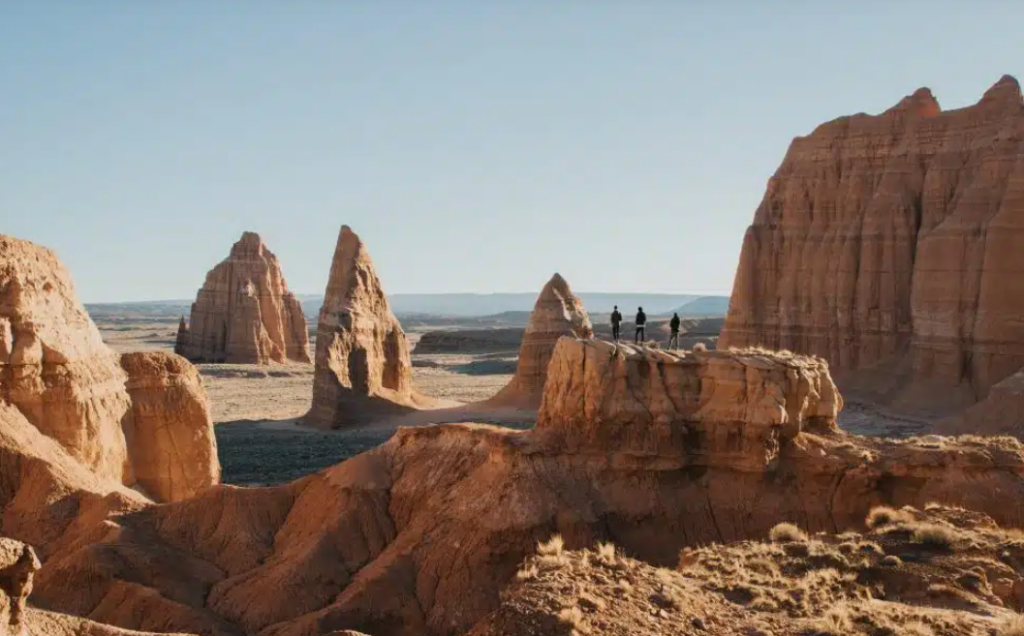
Cathedral Valley in Capitol Reef National Park – one of the plethora of treasures in southern Utah
by Spreck | Jul 4, 2026 | Uncategorized
It’s hard not to think about public lands and our national parks as we celebrate our nation’s sesquicentennial. They are an essential and special part of who we are. The words of author Wallace Stegner come to mind:
“National parks are the best idea we ever had. Absolutely American, absolutely democratic, they reflect us at our best rather than our worst.”
Stegner is right. We, the people, cherish all 63 of our national parks, from sea to shining sea.
Yosemite’s towering granite cliffs and thundering waterfalls. Paddling a canoe past flamingos in the Everglades. Sandstone collected over the eons, carved to perfection by a mighty Colorado River into the Grand Canyon. Yellowstone, teeming with Buffalo, Elk, and Moose amid geysers spewing steam from underground volcanos. Lush forests and perennial wildflowers in the Great Smoky Mountains atop Appalachia’s crest.
As we know it today, our National Park System emerged from the ashes of a nationwide debate over whether to preserve Yosemite National Park’s Hetch Hetchy Valley or allow San Francisco to dam and flood the valley as part of an improved water system.
By the early 20th century, Congress had created a handful of national parks. They were run separately with no common vision. There was no such thing as a Ranger; parks were often patrolled by the U.S. Army. Early advocates proposed the creation of a single agency to manage and protect our national parks. Pro-development forces, including forester Gifford Pinchot, opposed the idea, fearing harm would befall the timber industry.
Conflict over Hetch Hetchy, and by extension all of America’s national parks, came to a head in 1913. After being rebuffed by Presidents Theodore Roosevelt and William Howard Taft, San Francisco saw an opportunity with the newly elected Woodrow Wilson
The City was determined. The City pushed hard in Congress, and labeled opponents “nature lovers and fakers … who wage a sentimental campaign”. A local newspaper ridiculed naturalist John Muir by dressing him in women’s clothes, trying in vain to sweep away the Hetch Hetchy “flood”.
The “nature lovers” pushed back, generating more than 200 editorials in newspapers across the land which opposed the destruction Yosemite National Park for “parochial” interests. Debate captivated the U.S. Senate for 6 days in early December. San Francisco prevailed in the end, and built the O’Shaughnessy Dam. Our national consciousness, however, had been raised forever.
Less than three years later, a remorseful Congress passed the “Organic” Act, creating the National Park Service and ensuring that our parks would be managed as a national system. Subsequent proposals to build dams in Yellowstone in the 1930s and the Grand Canyon in the 1950s were defeated. No significant development has been allowed in any of our national parks over the last 100 years.
America’s model of preserving spectacular landscapes has been copied around the world, and now includes places like Tanzania’s Serengeti, Australia’s Great Barrier Reef and Ecuador’s Galapagos Islands. Since 1916, National Park Service Rangers have protected our own parks for us, for our children, and for generations to come.
Moreover, Muir’s activism gave birth to the modern environmental movement. Today, we recycle. We conserve water. We support public transportation. We regulate forestry and commercial fishing to keep industries sustainable. And we are investing heavily in alternative energy sources as we try to keep global temperatures from rising. We do these things hoping that the world our grandchildren inherit will look like the one we know now – or perhaps even a bit better.
Even as the conservation movement has become so many different things, our national parks are more popular than ever. Visit them and you will not only find your own countrymen, but citizens from countries around the world, many of which did not have the foresight to preserve some of their own very special places.
Hetch Hetchy’s legacy in American history is undeniable. Author Robert Righter got it right in the subtitle of his 2006 book, The Battle over Hetch Hetchy: America’s Most Controversial Dam and the Birth of Modern Environmentalism.
From day one, Restore Hetch Hetchy has always understood that returning Hetch Hetchy Valley to its natural splendor requires a plan that continues to meet the water and power needs of all communities which rely on the Tuolumne. Restore Hetch Hetchy and others have completed extensive analyses of what changes to the water system would be necessary. We are confident that not one drop of water supply need be lost.
Today, demand is down and the City’s other reservoirs obviate the need to store water in Hetch Hetchy Valley. Moreover, San Francisco has eschewed investments in groundwater banking, recycling and local reservoirs that other California water agencies have successfully pursued in recent decades. The City simply remains opposed to restoration.
Restore Hetch Hetchy has long sought to work cooperatively with San Francisco – to no avail. We are asking therefore Congress to engage the City – to initiate substantive discussion of the opportunity for restoration. After all, Congress permitted Hetch Hetchy Valley to be flooded before we really understood the importance of our national parks and when water supply options were fewer. Times have changed. There is a plethora of options for replacing the dam and reservoir in Hetch Hetchy Valley.
Imagine another Yosemite Valley – perhaps one with fewer roads and shops. Families picnicking along the river as they watch a valley return to life. Restoration inspiring communities across America and around the world. We do not need to live with mistakes of the past.
What better way to celebrate our nation’s natural heritage than to undo the destruction done to Yosemite and to return Hetch Hetchy Valley to the American people?
Happy 4th of July to all. If you have not had the opportunity to sign our petition, please do so. Showing support is important.
Spreck Rosekrans, Executive Director
by Spreck | Jun 4, 2026 | Uncategorized
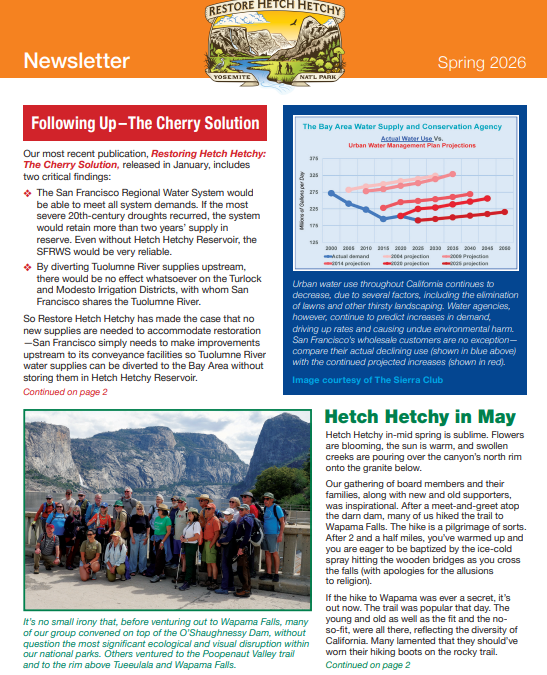
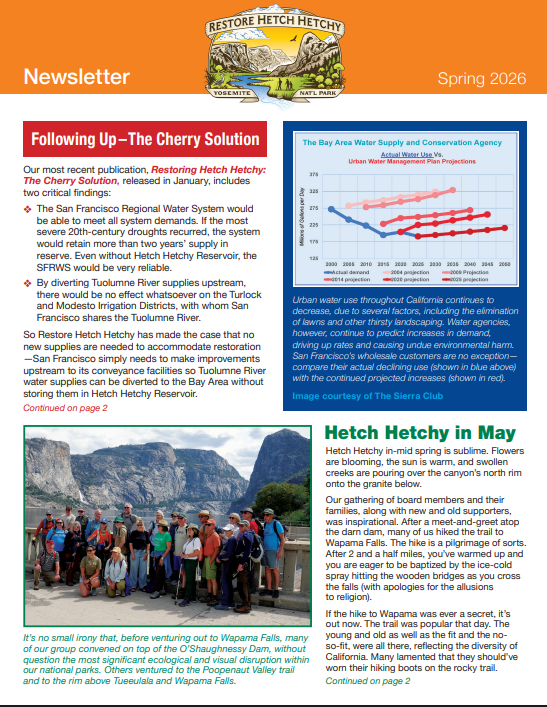
Our Spring Newsletter has been delivered to mailboxes and is posted online. If you have not received a hard copy but would like one – send an email to admin@hetchhetchy.org. Read about the follow up with elected officials to our Cherry Report, our early May trip to Hetch Hetchy, and our work with the National Park Service to improve access at Hetch Hetchy.
A bit more about fishing at Hetch Hetchy Reservoir. We’d heard rumors that access at Hetch Hetchy for fishing would likely be allowed before we wrote the newsletter, but we did not know when it might happen (the government can take a while to make changes). As we have noted, fishing itself was never explicitly prohibited – rather going below the high water mark of the reservoir was prohibited. So it was not possible to fish in any practical sense for most of the year.
The San Francisco Chronicle published a provocatively titled article about these new rules for fishing in Yosemite: Yosemite National Park’s permissive new fishing policies spark controversy. The article is really two stories. The first story is about the possibility that year round access will lead to overfishing. The second story, which includes some nice quotes from our friend David Gregory of Yosemite Outfitters, involves allowing access to Hetch Hetchy Reservoir for the first time.
We hope park visitors can now climb over the rocks to reservoir’s edge and catch some nice trout. The real fishing, however, will not take place in the reservoir but rather in the Tuolumne River when the reservoir is relocated and the valley is restored.
Also, if you support restoring Hetch Hetchy to its natural splendor, please do not forget to sign our petition. We plan to share a long list of signatures with our elected officials!
by Spreck | May 30, 2026 | Uncategorized
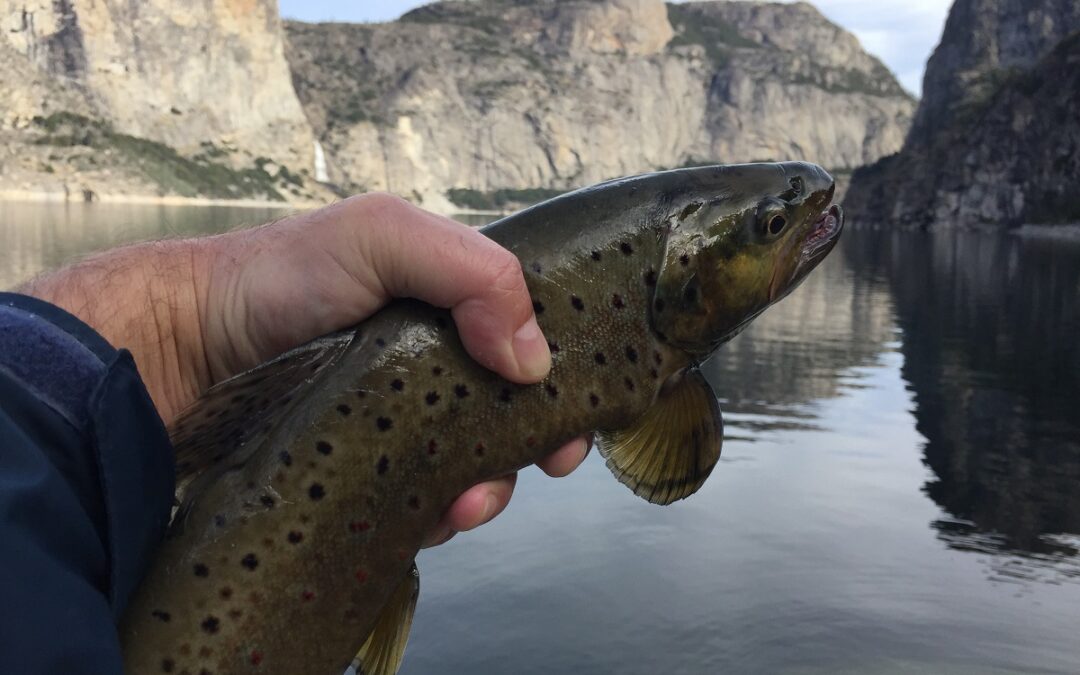
Last week, the National Park Service announced changes in fishing regulations throughout Yosemite, notably including opening Hetch Hetchy Reservoir to anglers. Hurrah!

Photo: Phil Akers, MyOutdoorBuddy.com
Superintendent Ray McPadden explained “Visitors can now enjoy fishing throughout the year, including in areas like Hetch Hetchy, with regulations that are easier to understand and more consistent with state guidelines.”
Fishing the reservoir is clearly something Congress expected when it passed the Raker Act, authorizing its construction a century ago. The change is most welcome, coming almost exactly two years after we joined with 24 organizations and businesses to urge the Park Service to allow fishing at Hetch Hetchy. It is always great to work with partners:
Aspen Outdoor Management Services ◊ California Sportfishing Protection Alliance Echo Cooperative ◊ Evergreen Lodge, Rush Creek Lodge & Firefall Ranch ◊ Fly Fisherman Magazine ◊ Friends of the River ◊ Merced Fly Fishers ◊ Nesporado Fly Fishing ◊ Northern California Council, Fly Fishers International Pasadena Casting Club ◊ Restore Hetch Hetchy ◊ Santa Barbara Fly Fishers ◊ Santa Cruz Fly Fishing Club ◊ Sierra Nevada Alliance ◊ Sonora Fly Company ◊ Stanislaus Fly Fishers ◊ Tight Line Therapy ◊ Trout Unlimited ◊ Trout Unlimited Central Sierra Chapter ◊ Tuolumne River Trust ◊ Yosemite Fly Fishing ◊ Yosemite Fly Fishing Guides ◊ Yosemite Adventure Guides ◊ Yosemite Outfitters
The official change in regulations is described in the Superintendent’s Compendium.
This previous Compendium language was deleted: Public access is prohibited below the high water mark of Hetch Hetchy reservoir, an elevation of 3796 feet (see the High Water Mark map in the appendix). This includes a prohibition on bathing, swimming within 1 mile of any tributary directly flowing into the reservoir. This restriction is necessary to maintain the high quality of water found in the Hetch Hetchy Reservoir as a clean municipal drinking water source free from microbial pathogens and other contaminants.
This language was added to the new Compendium:
-
- Fishing from the top of O’Shaughnessy Dam is prohibited.
- Visitors engaged in fishing at Hetch Hetchy Reservoir must limit bodily contact with water. Wading, swimming, or other bodily contact with the water (other than using one’s hands to retrieve or release fish) is prohibited.
Many anglers will still prefer stream fishing to reservoir fishing. Others will be drawn to this new opportunity, wondering what fish and what size of fish might be lurking in the water.
If you fish the reservoir, let us know – and send pictures. And please, while fishing Hetch Hetchy and elsewhere, be good stewards: obey the law and do not leave anything behind.
At Restore Hetch Hetchy, we are pleased as punch that fishing is allowed – now all 38 of California’s reservoirs which hold more than 200,000 acre-feet of water allow fishing.
We are far from done advocating for improved access at Hetch Hetchy (as we also advocate for the reservoir’s relocation and the valley’s restoration). Hetch Hetchy is still the only of these large reservoirs that does not allow boating – the reason is not water quality as the Compendium states but management concerns and perhaps San Francisco’s opposition. There is also still the issue of allowing camping at Hetch Hetchy as well as improving trails.
But let’s take a moment to savor progress to date and thank the National Park Service for listening!