by Spreck | Apr 4, 2026 | Uncategorized
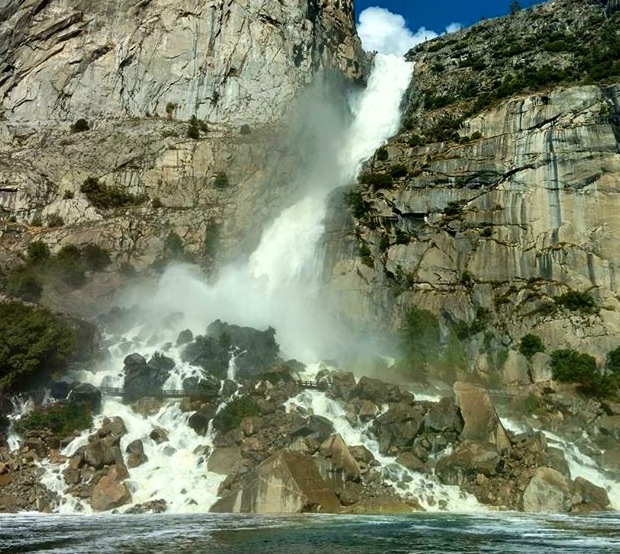
Wapama Falls won’t see this kind of volume in 2026. April and May will be the best times for waterfalls in Hetch Hetchy as well as in Yosemite Valley.
Wednesday’s headline in the The San Francisco Chronicle “California in for ‘ugly summer’ amid one of the worst snowpacks on record” was an attention grabber. How bad is it really?
Its worth checking in at the end of March – halfway through the 2026 “water year” (water years run from October through September).
The April 1 San Francisco Chronicle reports “State measurements on April 1, the closely watched date when snow levels historically reach their peaks, show that snowpack in the Sierra Nevada, southern Cascades and Klamath Mountains is a meager 18% of average.”
We aren’t sure where the 18% number comes from. The State’s estimates for rivers in the Sierra Nevada, including the Tuolumne, hover around 50% of average. See the California Data Exchange Center’s B-120 WATER SUPPLY FORECAST UPDATE SUMMARY for March 24.
While there is no such thing as an average year weather-wise, 2026 has indeed been odd. We had a large early season storm in November, significant rain in early January and a cold front bringing mostly snow at the end of February – and little else. Then a heat wave struck. San Francisco saw 90 degrees in March for the first time ever and Sierra snow started to melt quickly.
Focusing on the Tuolumne River (where, like much of the State, good record keeping goes back to 1922):
- For the entire water year, we are expecting 1,436,000 acre-feet, 78% of average.
- For the April-July snowmelt period, we are expecting 640,000 acre-feet, 54% of average.
It’s a dry year, for sure, but not among the driest. We hope for better next year. In addition to water supply concerns, park visitors will need to go earlier to see Yosemite’s waterfalls this year.
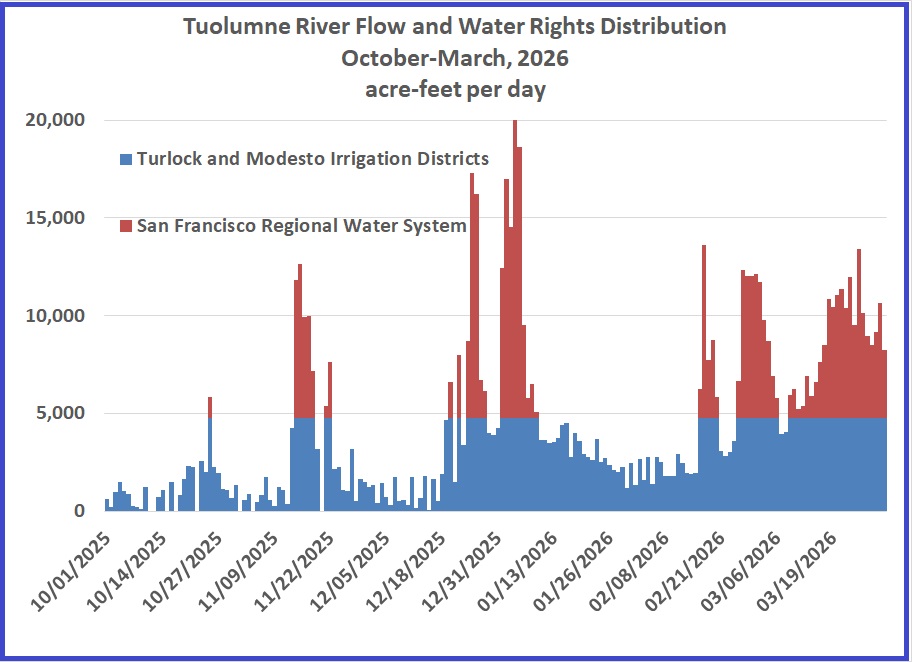
San Francisco’s total share of the Tuolumne River, determined by daily flows and shown in red, has well surpassed its annual demand, and will increase as the albeit meager snowpack continues to melt.
The Chronicle also notes the San Francisco Regional Water System has ample supplies: “The San Francisco Public Utilities Commission and East Bay Municipal Utility District, also among the big water providers in the Bay Area, operate reservoirs in the Sierra Nevada, which they say have ample water for the near term. Supply challenges for these agencies would arise after multiple dry years.”
This is an understatement. At least in San Francisco’s case, this year’s rain and snow has brought plenty of water – more that 300,000 acre-feet during the first six months of the year (compared to its demand of only 220,000 acre-feet for the entire water year). So the only impact may be that reservoirs will stop filling at the end of May rather than a month or so later).
by Spreck | Mar 15, 2026 | Uncategorized
Our most recent report, The Cherry Solution, demonstrates that San Francisco does not need Hetch Hetchy Reservoir for its water supply. With the city’s recent 19% reduction in demand, San Francisco could meet customer needs by relying on its other reservoirs — and would retain more than two years’ worth of storage even after a recurrence of the worst drought of the 20th century.
We have therefore asked Congress and San Francisco to work together on a plan to restore Hetch Hetchy Valley in Yosemite National Park.
But what if the 21st century brings longer or more severe droughts as a result of climate change?
We do not know whether it will be drier overall or whether droughts will last longer. We do expect more rain, less snow, and earlier runoff as temperatures rise.
What we do know is that San Francisco will retain strong options: groundwater recharge, water recycling, and local surface storage projects can diversify and strengthen supply if needed. Other California communities have successfully pursued these approaches in recent decades, often to accommodate environmental restoration projects throughout the state.
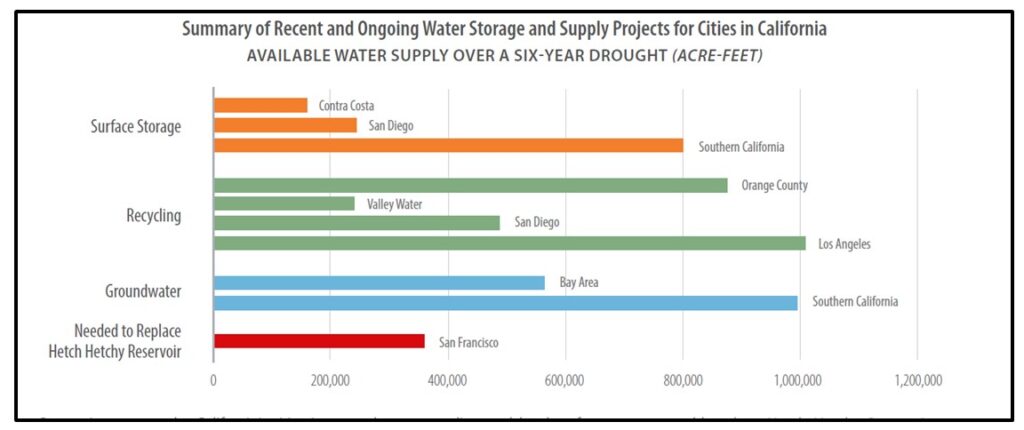
Recent investments by California’s cities in groundwater banking, recycling, and local surface storage would replace Hetch Hetchy Reservoir more than fifteen times over. The San Francisco Public Utilities Commission has the opportunity — and the tools — to pursue any or all of these strategies. (See Yosemite’s Opportunity for more information.)
Planning for the future means planning not just for reliable water supplies, but for protecting the environment as well. None of us envisions a future so narrowly focused on extracting water for human use that we abandon the natural world. No one imagines drying up every river and wetland. No one imagines damming Yosemite Valley. So why can we not restore Hetch Hetchy?
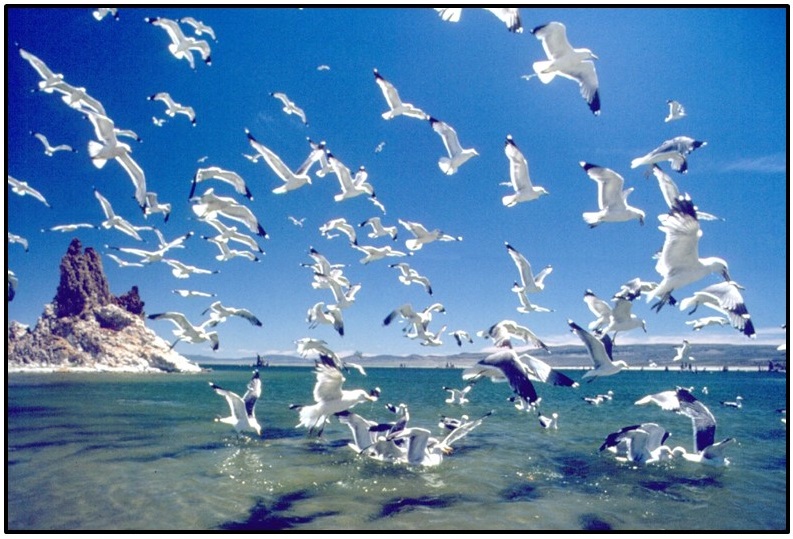
Mono Lake. We have already reduced diversions from the streams feeding Mono Lake, reversing the decline in its water level. Mono Lake is a critical habitat and breeding ground for a wide variety of waterbirds. Los Angeles has invested heavily in water conservation and recycling, as well as groundwater banking and Diamond Valley Reservoir through its wholesaler, the Metropolitan Water District of Southern California.
Trinity River. As diversions from the Trinity River in northern California have been reduced, farmers in the San Joaquin Valley have invested in drip irrigation systems that, laid end to end, would reach the moon and back — spurring profitable expansion into nut orchards and other high-value crops. Restoring the Trinity and its neighbor, the Klamath, is particularly important for the tribes whose cultures and livelihoods have long depended on historic salmon runs..
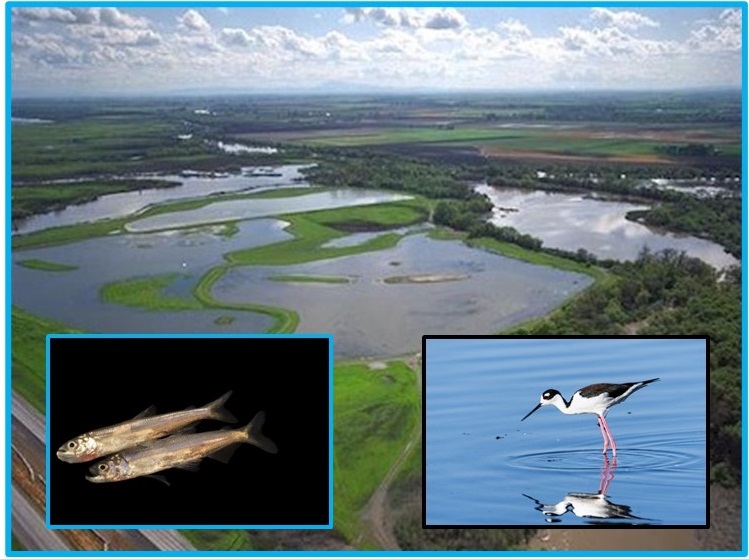
Sacramento–San Joaquin Delta and Central Valley. Rules now limit water exports from the Bay-Delta to protect both anadromous and estuarine fish — including the longfin smelt — while substantial supplies are being directed toward rewatering previously drained wetlands..
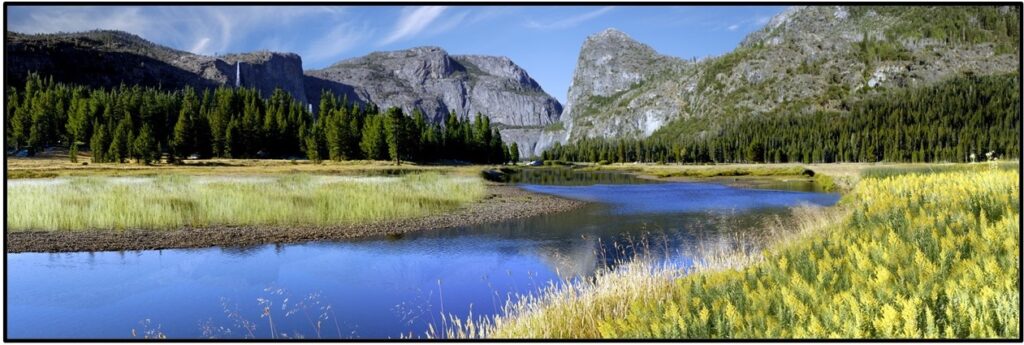
Hetch Hetchy: Returning Hetch Hetchy to its natural splendor would restore a truly spectacular landscape, recreating alpine meadows and riparian woodlands on a grand scale. It would make Yosemite National Park whole again — and inspire a new generation to return, again and again, to watch a valley come back to life.
There is no opportunity like this anywhere in the world. Hetch Hetchy Valley can and should be restored. Not a drop of water supply need be lost.
by Spreck | Feb 20, 2026 | Uncategorized
Hetch Hetchy is a story that continues to fascinate. We focus on the opportunity for restoration – what it means for Yosemite National Park and how it would inspire future generations.
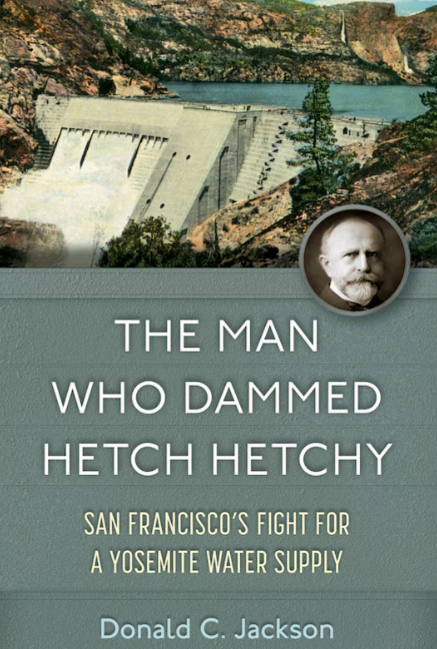
In The Man Who Dammed Hetch Hetchy: San Francisco’s Fight for a Yosemite Water Supply, however, Professor Donald C. Jackson focuses on the effort to design the project and authorize the dam by passing the Raker Act in Congress. It is a very good book and well told – even if the material is frustrating at times for us “nature lovers”.
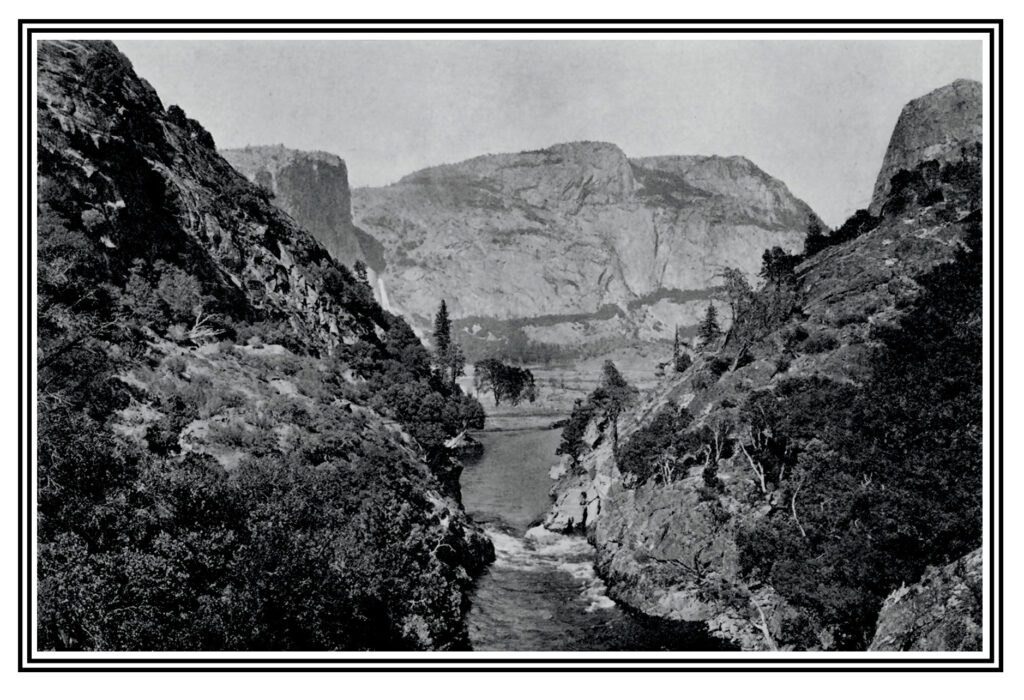
Was Hetch Hetchy even a cost-effective place to develop or was the narrow granite slot just too enticing a place to build a dam?
Jackson readily acknowledges that no one person gets full credit – not Michael Maurice O’Shaughnessy, the chief engineer who built the dam and for whom it is named – not John Raker who carried the legislation – and not even James Phelan, the former Mayor who personally filed for water rights on the Tuolumne before turning them over to the City of San Francisco.
The Man Who Dammed Hetch Hetchy is about John Freeman, the consulting engineer whose 421 page report dwarfed previous treatises by City officials, overwhelmed the Army Board of Engineers, and compelled Congress to pass legislation. Freeman sold the project as one that would provide access for the general public, not just the few “nature lovers” who, he claimed, wanted Hetch Hetchy for themselves. The water system Freeman designed and successfully promoted was also much larger than what San Francisco had previously proposed.
Indeed, had San Francisco not retained Freeman, Hetch Hetchy may never have been dammed.
The Freeman Report, officially titled The Hetch Hetchy Water Supply for San Francisco, 1912, was written in response to Secretary of the Interior Richard Ballinger’s order that San Francisco “show cause” as to why it needed to dam Hetch Hetchy rather than develop other means of obtaining water for the City. Ballinger intended for the Army Board of Engineers to review whatever the City submitted.
The Freeman Report is an impressive document indeed. The first section extols the compatibility between recreation and municipal reservoirs, with ample pictures of picnics, boating and lodges (recreation that has never been made available – see Keeping Promises, Restore Hetch Hetchy, 2021). Freeman’s design of the dam and the gravity-fed conveyance system to the Bay Area are meticulous and beautifully done. His analysis of alternative water supplies, however, as Jackson notes, primarily relied on work done by previous City engineers Carl Grunsky and Marsden Madsen and is less rigorous.
Did the Army Board of Engineers really review the Freeman Report or simply rubber stamp it? In a “A National Park Threatened”, the first of its six Hetch Hetchy editorials in 1913, The New York Times noted “The engineers say in their report that they have merely passed on such data as were presented by the officials of San Francisco, since they had neither time nor money to investigate independently the various projects presented.”
Jackson does provide detail of the Army Board’s review of the Freeman report, but a reasonable person may conclude that Freeman had committed his heart and soul to the Hetch Hetchy project and the Army Board never dug deep enough to see if it really was a better alternative (Professor Jackson may disagree.)
Even ignoring its damage to Yosemite, was damming Hetch Hetchy the best option for San Francisco? Or were the narrow granite slot and potential for hydropower simply too enticing for City engineers to consider an alternative? It took 21 years for water to get to the City after the Raker Act was passed. The dam and reservoir were completed in 1923 but water did not reach San Francisco until 1934 after the Coast Range Tunnel was completed. Chief Engineer Michael Maurice O’Shaughnessy, nicknamed “More Money” O’Shaughnessy, had to ask San Franciscans to buy more bond several times to finish the dam project.
By contrast it took the East Bay Municipal Utilities District only 5 years to develop water on the Mokelumne River for Oakland and Berkeley – in large part because they built a pipeline around Mt. Diablo rather than a tunnel.
After the1906 earthquake, however, San Francisco was hell bent on damming Hetch Hetchy, squashing any and all opposition. William Randolph Hearst and his SF Examiner smeared Taggart Aston, an engineer who had written to Congress opining that San Francisco should develop the Mokelumne River (see above) at lower cost. Courts later found Hearst and the Examiner guilty of libel, but by that time the debate over Raker Act was over and construction had begun.
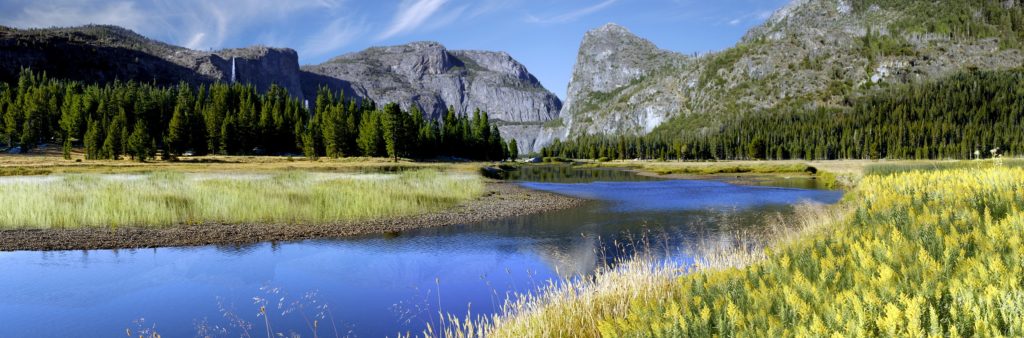
As they say, there’s no use crying over spilt milk. Focused the future on, The Cherry Solution, our most recent report, demonstrates how Hetch Hetchy Valley can be returned to its natural splendor while maintaining a reliable water supply for San Francisco and its customers.
by Spreck | Feb 1, 2026 | Uncategorized
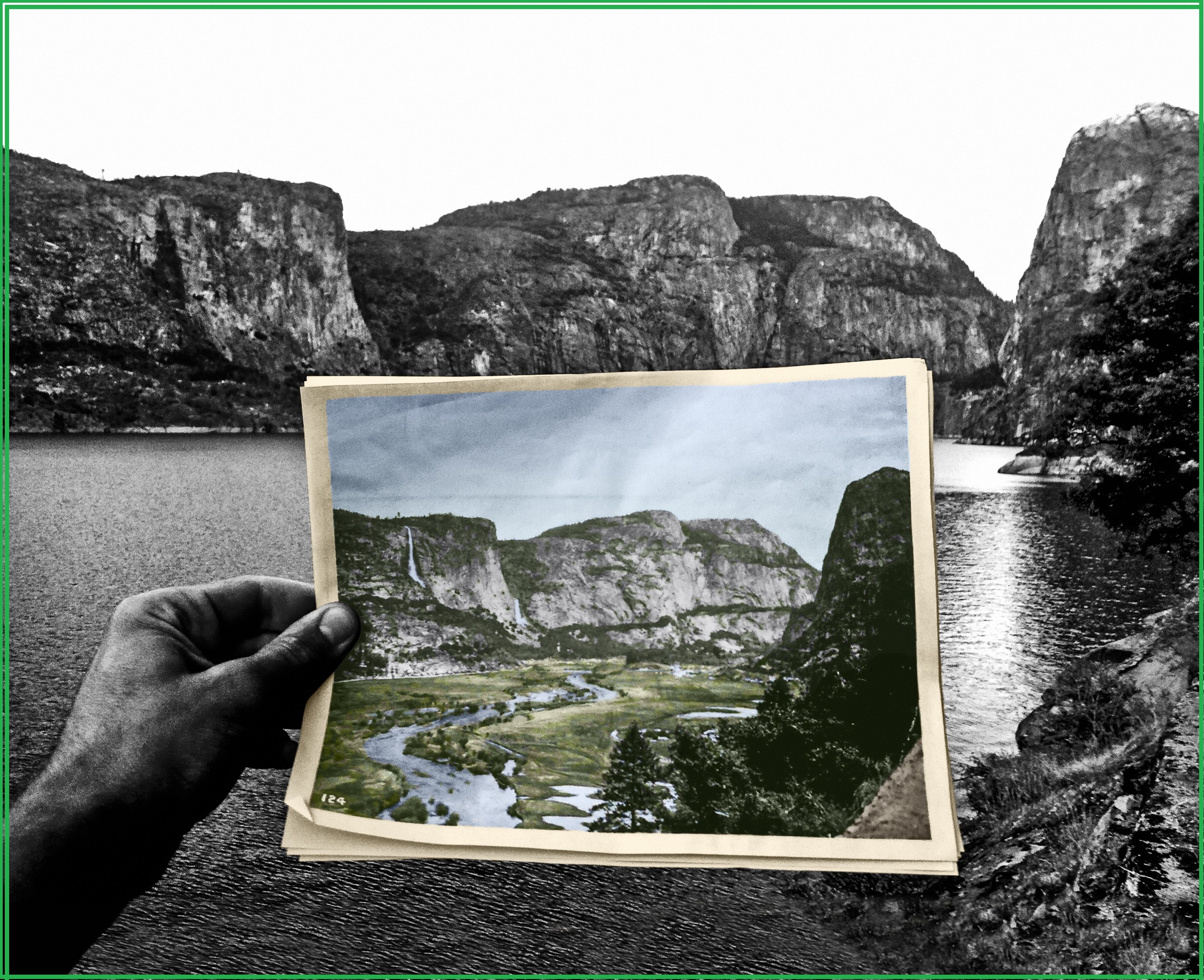
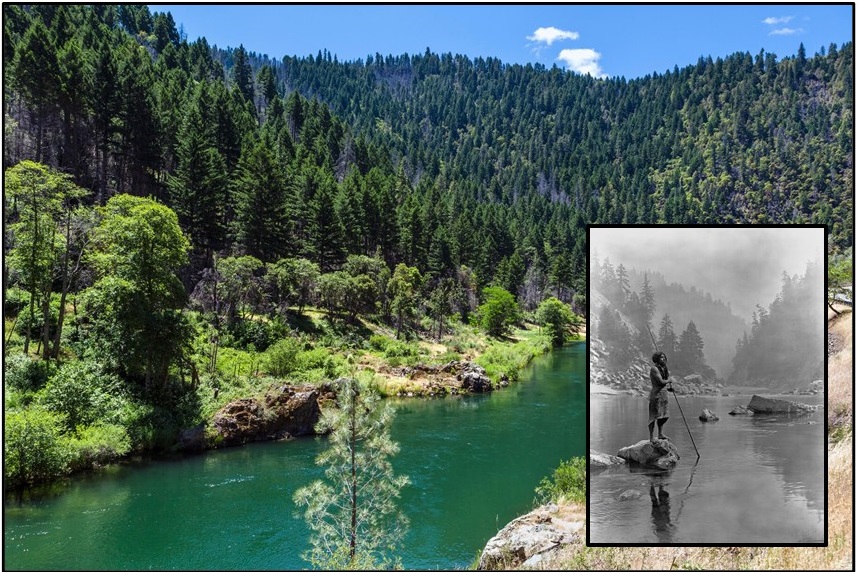
Sierra News Online posted one of our favorite pictures – the snapshot taken by Matt Stoecker during the filming of Patagonia’s “Damnation”. The inset is Isaiah West Taber’s iconic 1908 photo of Hetch Hetchy.
Our Cherry Solutions report shows that, with reduced demand, San Francisco’s Regional Water System would be extraordinarily reliable even if water were no long stored at Hetch Hetchy and the valley were returned to its original splendor.
Our message is getting through in the Central Valley and Sierra Nevada, with two nice stories this week:
We hope to get additional coverage, especially in the Bay Area, and look forward to a response from the San Francisco Public Utilities Commission – even though they are highly unlikely to concur with our findings.
San Francisco’s experience is consistent with that of urban water agencies throughout California, as reported in “Water Demand Projection Accuracy and Demand Management Trends in California Cities”, a peer-reviewed journal article by researchers Johanna Capone and Landon Marston in the Virginia Tech Department of Civil and Environmental Engineering. They note:
“Municipal water suppliers consistently overestimated future water demand, with one California study finding 98% of water demand forecasts overestimated water demand by an average of 25% (Abraham et al., 2020), highlighting a critical and persistent inaccuracy in water resource planning.”
These findings are good news for California’s cities as well as for our campaign to Restore Hetch Hetchy.
Elsewhere in California, however, water supply struggles continue. Groundwater overdraft continues in many parts of the Central Valley. If you include the amount of water needed to grow the food we eat to what we use in our homes, calculations of personal water consumption are increased several times over.
On the Colorado River the longstanding discrepancy between allocation and availability is coming to a head.
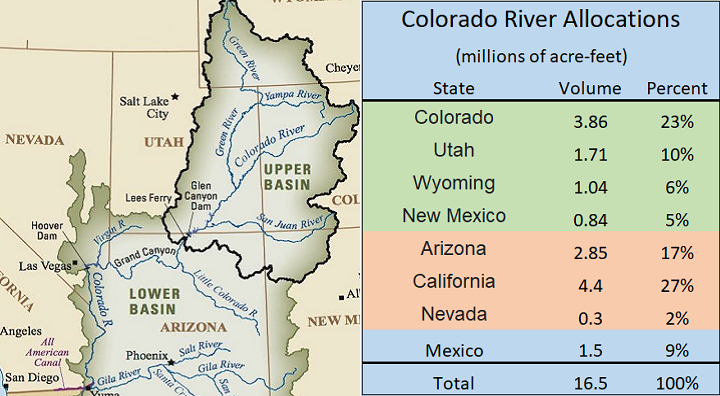
California’s current allocation of 4.4 million acre-feet per year from the Colorado River is exactly 20 times what San Francisco’s Regional Water System has used over the past decade! Hetch Hetchy is small potatoes indeed when it comes to water supply but huge when it comes to the legacy of our national parks and the the opportunity for Yosemite.
The ongoing negotiations over allocations of limited Colorado River water between the seven “Basin States” and Mexico is ongoing. Secretary of the Interior Doug Burgum called a summit meeting of Governors to try to break the logjam – to no avail so far.
Passions run high among the Basin States, who see the terms of the 1922 Colorado River Compact (“The Law of the River”) as chiseled in stone. The Colorado River’s flow in the 21st century has averaged only 12.5 million acre-feet, far less that both the 18 million acre-feet when the Compact was created and the 16.5 million acre-feet presently allocated to the Basin States and to Mexico.
We wish the Secretary luck, but guess the matter will eventually be decided in court.
by Spreck | Jan 25, 2026 | Uncategorized
It was great to see media coverage for our Cherry Solution report.
Both articles are short but on point – noting the unprecedented history of allowing a dam in a national park, and that sharply increased demand across its Regional Water System makes it far easier for San Francisco to do the right thing – to relinquish the reservoir so the valley can be restored.
There is widespread support for restoration (see below, for example), albeit to date reluctance to address the issue in Congress and resistance among officials in San Francisco. This needs to change. Hetch Hetchy can be restored and San Francisco can get all the water it needs from the Tuolumne River. It’s a win-win. We are hopeful that time may be right for the San Francisco Mayor and Congress to take advantage of the opportunity at hand.
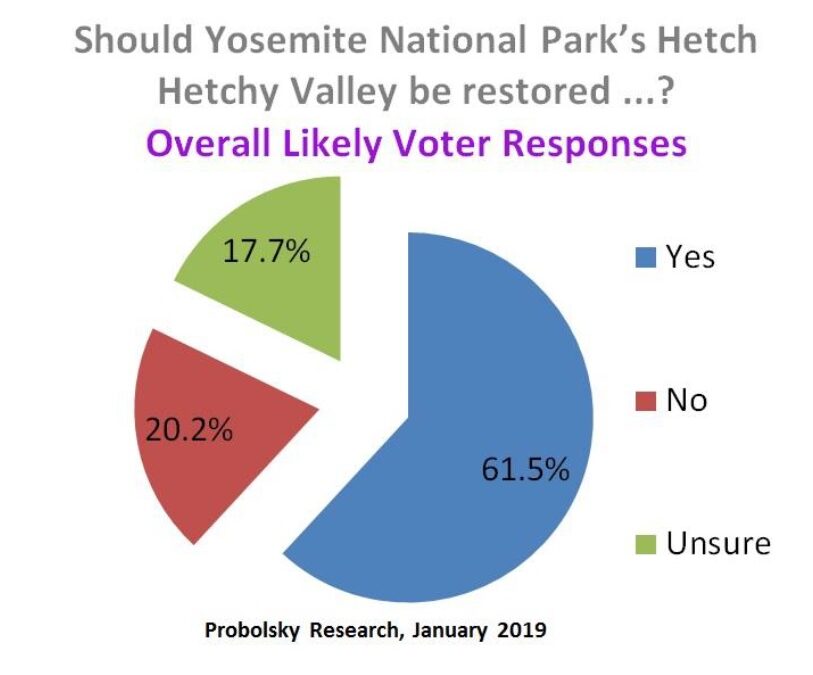
In 2019, Probolsky Research, an independent firm, asked the following question of 903 respondents:
California’s Yosemite National Park once included two glacier-carved valleys – Yosemite Valley along the Merced River and Hetch Hetchy Valley along the Tuolumne River. In 1913, Congress allowed San Francisco to dam Hetch Hetchy Valley and turn it into a reservoir for the City.
Should Yosemite National Park’s Hetch Hetchy Valley be restored, if it can be accomplished without impacting San Francisco’s water supply?
61.5% of likely voters responded yes.
See summary for a demographic breakdown.
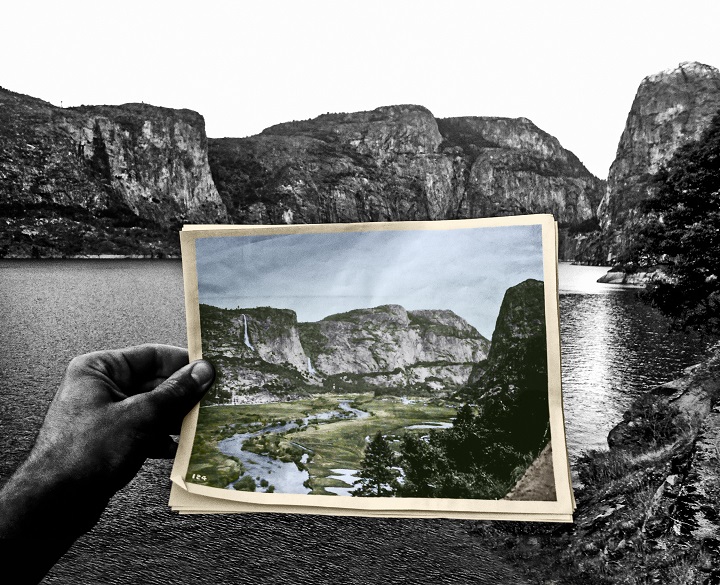
Go to Hetch Hetchy – it is easy to imagine the glory of restoring the valley. Photo: Matt Stoecker
by Spreck | Jan 19, 2026 | Uncategorized
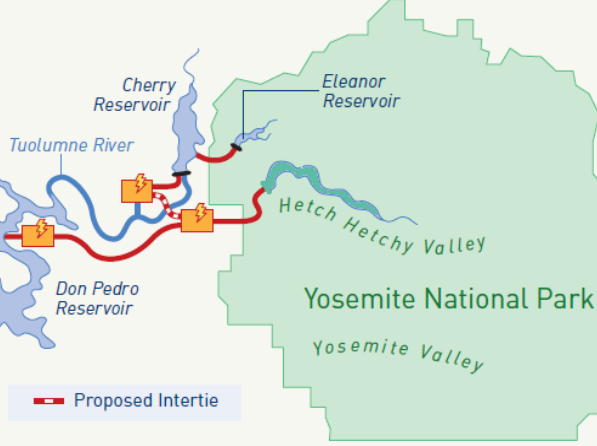
With sharply reduced demand over the past decade, San Francisco can meet its full water demands without storing water in Hetch Hetchy Reservoir – simply by connecting Cherry Reservoir to its conveyance system!
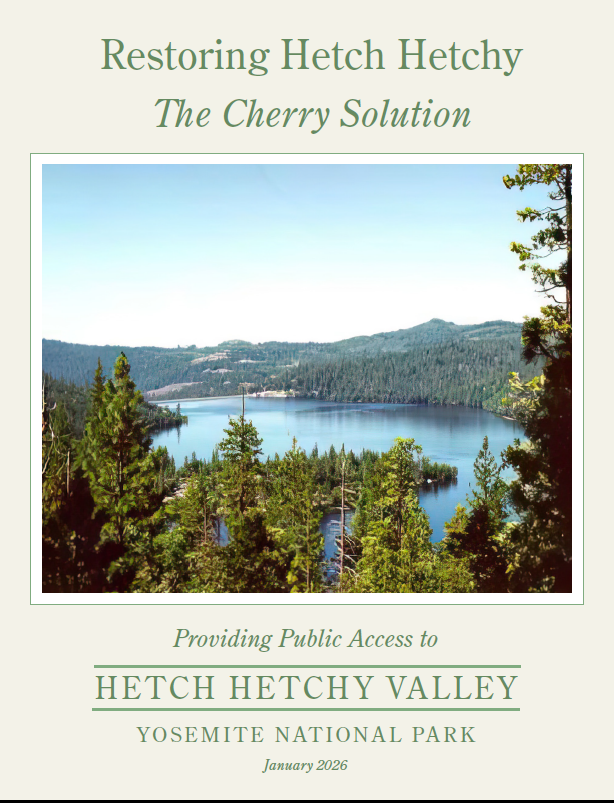
This finding is the conclusion of our groundbreaking new report: Restoring Hetch Hetchy: The Cherry Solution. Since Hetch Hetchy Reservoir is no longer needed to provide water to San Francisco and its customers, the original justification for allowing a reservoir in Yosemite National Park is invalid. The reservoir should be emptied and the valley restored.
The Cherry Solution is short, but rich in detail and based on detailed hydrologic modeling. Restore Hetch Hetchy invites supporters, skeptics and opponents alike to give it a hard look. More information about the report is posted on the Cherry Solution page.
See today’s press release – New Report: Water Demand is Down, Connect Cherry Reservoir, Restore Hetch Hetchy.
San Francisco owns and stores water in Cherry and Eleanor Reservoirs, but does not deliver those supplies to its customers. Under our proposal, the City would install a short intertie which would allow both full water deliveries and the return of Hetch Hetchy Valley to its natural splendor.
We have sent The Cherry Solution to all members of Congress as well as to a plethora of officials in San Francisco and other Bay Area cities – accompanied by letters cosigned by former Secretary of the Interior Donald P. Hodel, former State Senator Lois Wolk and Robert Hanna – great great grandson of John Muir. The report, letters and other information are posted on our Cherry Solution page. If you’d like a hard copy but haven’t received one let us know by email to admin@hetchhetchy.org.
The Cherry Solution is a relatively simple fix. Until recently, Restore Hetch Hetchy has advocated that San Francisco pursue supplies via groundwater banking, recycling, new reservoirs, transfers and conservation (See, for example, Yosemite’s Opportunity). But with substantially reduced demand, none of those options are necessary.
It’s time for Congress and San Francisco to work cooperatively to restore Hetch Hetchy Valley and make Yosemite National park whole again.